Glass in Minecraft isn’t just a building material, it’s the backbone of everything from sleek modern towers to sprawling underwater observation domes. Whether you’re looking to add natural light to your base, create stunning stained-glass murals, or build that perfect greenhouse for your crops, understanding how glass works is essential for any builder.
But here’s the thing: glass has quirks. Break it without the right enchantment, and it’s gone forever. Choose the wrong variant, and your redstone contraptions might not work as intended. With multiple types, standard, stained, tinted, and panes, plus specific mechanics around light transmission and blast resistance, there’s more depth to this transparent block than most players realize.
This guide covers everything from basic crafting to advanced building techniques, helping both new players and seasoned builders make the most of glass minecraft blocks in their worlds. Let’s jump into what makes glass one of the most versatile materials in the game.
Table of Contents
ToggleKey Takeaways
- Breaking glass without Silk Touch destroys it completely, making it the #1 mistake in glass minecraft builds—always keep a Silk Touch tool handy when working with glass blocks.
- Glass comes in four main variants: standard glass, glass panes, stained glass in 16 colors, and tinted glass that blocks light while remaining transparent, each serving different building purposes.
- Smelting sand in a furnace is the straightforward way to produce glass, with blast furnaces offering no speed advantage over standard furnaces for this process.
- Glass transmits light at 100% efficiency and has weak blast resistance of only 0.3, making it vulnerable to creeper explosions but ideal for greenhouses and underwater observation structures.
- Glass panes are more resource-efficient than full blocks (6 blocks yield 16 panes) and automatically connect to adjacent panes, perfect for realistic windows with visible frames in your Minecraft builds.
- Combining glass strategically with complementary materials like concrete, quartz, wood, and stone creates depth and visual interest—white concrete with glass achieves a luxury modern aesthetic, while dark oak wood with glass gives a cozy cabin vibe.
What Is Glass in Minecraft?
Glass is a transparent solid block obtained by smelting sand in a furnace. It’s been a core building material since Minecraft’s early development, allowing players to create windows, walls, and structures that let light pass through while keeping mobs and elements out.
Unlike most blocks in Minecraft, glass doesn’t drop itself when broken with a standard tool. You’ll need a tool enchanted with Silk Touch to recover glass blocks intact, otherwise, they shatter into nothing. This makes glass somewhat precious during early-game builds when Silk Touch isn’t readily available.
Glass comes in several variants: standard clear glass, glass panes (thinner, connectable versions), stained glass in 16 different colors, and tinted glass that blocks light while remaining transparent. Each type serves different purposes, from purely aesthetic choices to functional builds involving light mechanics.
The block has a blast resistance of 0.3, making it vulnerable to creeper explosions and TNT. That’s significantly weaker than most building materials, so placement matters when designing bases in survival mode.
How to Craft Glass: Step-by-Step Process
Gathering Sand for Glass Production
Sand is the only ingredient you need to make glass, and it’s one of the most abundant resources in Minecraft. You’ll find sand blocks in:
- Desert biomes (massive quantities, easiest farming)
- Beach areas along oceans, rivers, and lakes
- Badlands/Mesa biomes (red sand variant, works identically)
- Underwater in ocean floors
You can mine sand with any tool, but a shovel is fastest. Enchanting your shovel with Efficiency speeds up collection significantly, Efficiency V lets you insta-mine sand, making bulk collection painless.
One thing to watch: sand obeys gravity. When mining in desert temples or near overhangs, breaking a bottom sand block causes everything above to fall. This can work in your favor for quick collection, but it’s also easy to get buried if you’re not careful.
For large-scale glass production (think modern skyscrapers or massive greenhouses), you’ll want to set up a dedicated sand farm or mark a nearby desert for strip-mining operations.
Smelting Glass in a Furnace or Blast Furnace
Once you’ve got sand, smelting is straightforward:
- Place sand in the top slot of a furnace or blast furnace
- Add fuel to the bottom slot (coal, charcoal, lava bucket, etc.)
- Wait for the smelting to complete
A regular furnace takes 10 seconds per glass block. A blast furnace doesn’t actually speed this up, it only works faster for ores and metal items, not sand. So stick with a standard furnace for glass production.
For efficiency, set up multiple furnaces running simultaneously. Eight furnaces processing sand in parallel will net you stacks of glass far faster than waiting on a single unit. Some players prefer using a smoker for food and dedicating their furnaces purely to sand and ore, keeping production lines clean.
Fuel efficiency matters too. A single piece of coal smelts 8 items, so one coal = 8 glass blocks. Lava buckets smelt 100 items each, making them the most efficient fuel source if you have access to a renewable lava farm (common in 1.17+ with dripstone and cauldrons).
All Glass Types and Variants in Minecraft
Standard Glass Block
The basic glass block is a full 1×1×1 cube. It’s completely transparent, allows full light transmission (light level passes through undiminished), and can be placed in any orientation.
Standard glass is the go-to for large windows, walls, and ceilings where you want maximum visibility. It connects seamlessly when placed side-by-side, creating clean, unbroken surfaces perfect for modern architecture.
Glass Panes
Glass panes are thinner versions of standard glass blocks, resembling actual window panes. Six glass blocks crafted in a 3×2 pattern yield 16 glass panes, making them more resource-efficient for certain builds.
Key differences from full blocks:
- Panes are 2 pixels thick instead of a full block
- They automatically connect to adjacent panes and some blocks
- They don’t conduct redstone signals (full glass blocks don’t either, but panes’ thinness makes this more obvious)
- Perfect for realistic windows with visible frames
Glass panes connect to each other and to solid blocks, creating cross-shapes and corner configurations automatically. This makes them excellent for traditional windows with borders but can look awkward if you’re going for completely seamless glass walls.
Stained Glass and Stained Glass Panes
Stained glass comes in all 16 Minecraft dye colors: white, orange, magenta, light blue, yellow, lime, pink, gray, light gray, cyan, purple, blue, brown, green, red, and black. Light passing through stained glass doesn’t change color (unlike real-world physics), but the blocks themselves add vibrant hues to builds.
Crafting stained glass requires:
- 8 glass blocks + 1 dye = 8 stained glass blocks
You can also craft stained glass panes directly (8 stained glass blocks in a 3×2 pattern = 16 panes), or dye standard glass panes the same way you’d dye glass blocks.
Stained glass is essential for artistic builds, churches, mosaics, pixel art, and decorative features all rely on the color variety. Combining different colors creates depth and visual interest that clear glass can’t match. Many players studying advanced building techniques incorporate stained glass into signature designs.
Tinted Glass
Tinted glass was added in the Caves & Cliffs update (1.17) and works differently from every other glass type. It’s visually transparent (you can see through it), but it blocks light completely. No light passes through tinted glass, making it unique for builds where you want visibility without illumination.
Crafting tinted glass:
- 1 glass block + 4 amethyst shards (arranged around the glass) = 2 tinted glass blocks
Unlike standard glass, tinted glass drops itself when broken without needing Silk Touch. This makes it more forgiving in survival builds.
Tinted glass is perfect for:
- Mob farms where you need to see inside dark spawning chambers
- Aesthetic builds requiring darker glass without blocking the view
- Redstone contraptions that rely on specific light levels
Amethyst shards come from amethyst geodes, so you’ll need to locate one of these underground structures first. They’re fairly common below Y-level 30, especially in mountainous and cave-heavy areas.
Best Uses for Glass in Your Minecraft Builds
Creating Modern and Aesthetic Building Designs
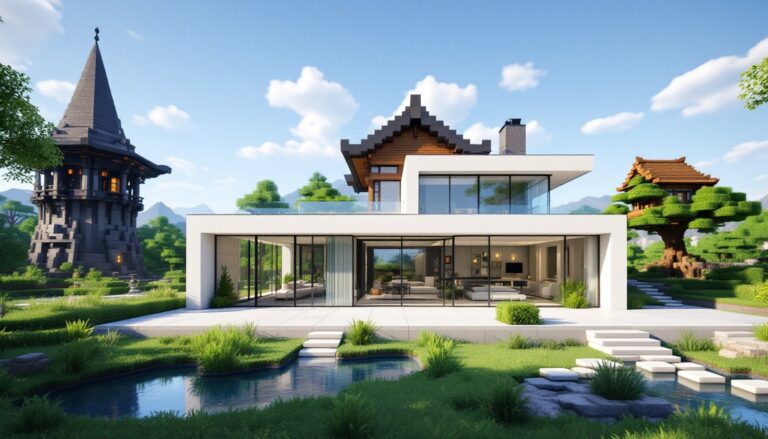
Glass is the defining material for modern architecture in Minecraft. Sleek skyscrapers, minimalist homes, and contemporary office buildings all rely heavily on glass walls and ceilings to achieve that clean, open aesthetic.
Combining glass with materials like quartz, concrete, and blackstone creates striking contrasts. White concrete frames with floor-to-ceiling glass panels deliver that high-end luxury look, while dark oak or spruce wood paired with glass gives a cozy cabin-modern hybrid vibe.
For maximum impact:
- Use full glass blocks for uninterrupted views
- Mix in glass panes for detailed window frames
- Layer stained glass in subtle colors (light gray, white, cyan) for depth without overpowering the design
Corner windows, where two glass walls meet at 90 degrees, are a signature of modern builds. They’re simple to execute but dramatically open up interior spaces.
Underwater Bases and Observation Rooms
Glass is essential for underwater construction, allowing players to build bases, tunnels, and observation domes beneath oceans and rivers. The ability to see marine life, tropical fish, dolphins, sea turtles, while staying dry makes glass the only viable choice for these builds.
When building underwater:
- Start by creating an air pocket using temporary blocks
- Replace sections with glass blocks to form walls and ceilings
- Use conduits for water breathing and visibility while working
Domed observation rooms create incredible immersion, especially when placed near coral reefs or kelp forests. Some players exploring modding options add shaders to enhance underwater lighting effects through glass.
Glass panes work underwater too but can look less impressive due to their thinness. Full blocks typically deliver better visual results for large observation windows.
Greenhouses and Farming Structures
Greenhouses leverage glass’s light transmission properties to grow crops indoors while protecting them from mobs and weather. Since crops need light level 9+ to grow, glass roofs let sunlight through while creating enclosed, safe farming spaces.
Design tips for greenhouses:
- Use glass blocks for roofs to maximize light intake
- Combine with glass panes for walls if you want detailed framing
- Add lanterns or glowstone inside for 24/7 crop growth
- Include water sources in the floor for hydrating farmland
Glass greenhouses also look fantastic aesthetically. A well-designed greenhouse with organized crop rows, pathways, and decorative elements becomes a centerpiece of any base. Stained glass roofs in green or yellow tones add thematic flair without blocking light.
Decorative Elements and Interior Design
Beyond functional uses, glass works as a decorative element in countless ways:
- Skylights bring natural light into builds without exterior windows
- Glass floors over water, lava, or void create dramatic visual effects
- Display cases for valuable items (combine glass with item frames and armor stands)
- Room dividers that separate spaces without blocking sightlines
- Aquariums for displaying tropical fish or axolotls
Stained glass excels at decorative work. Create mosaics, pixel art, or abstract patterns using different colors. Some builders use stained glass to mark different sections of large bases, blue for storage, green for farms, red for redstone, etc.
How to Dye and Customize Glass
Obtaining Dyes from Natural Resources
Before you can create stained glass, you need dyes. Each of Minecraft’s 16 dye colors comes from different sources:
Primary natural sources:
- White dye: Bone meal (from bones) or lily of the valley
- Red dye: Poppies, rose bushes, red tulips, or beetroot
- Yellow dye: Dandelions or sunflowers
- Blue dye: Lapis lazuli or cornflowers
- Green dye: Smelting cacti in a furnace
- Black dye: Ink sacs (from squids) or wither roses
Secondary dyes (crafted by combining):
- Orange: Red + yellow
- Magenta: Purple + pink, or red + blue + white
- Light blue: Blue + white
- Lime: Green + white
- Pink: Red + white
- Gray: Black + white
- Light gray: Gray + white, or black + 2 white
- Cyan: Blue + green
- Purple: Blue + red
- Brown: Cocoa beans (found in jungle biomes)
Flower farms make dye collection sustainable. Plant flowers on grass blocks and use bone meal to generate more. Sheep farms also work, dye a sheep, shear it, and it regrows colored wool (though this is more useful for wool than for glass dyeing).
Crafting Stained Glass Blocks and Panes
Once you’ve got dyes, crafting stained glass is simple:
For stained glass blocks:
- Place 8 glass blocks in a crafting table, surrounding the center slot
- Put 1 dye in the center slot
- Result: 8 stained glass blocks in that color
For stained glass panes:
Option 1 (direct):
- Use 8 glass panes surrounding 1 dye
- Result: 8 stained glass panes
Option 2 (indirect):
- First craft stained glass blocks
- Then craft panes from those blocks (6 blocks = 16 panes)
The direct method is slightly more resource-efficient if you know you want panes from the start, but most players craft blocks first for flexibility.
You can’t dye already-placed glass, you have to craft stained glass first, then place it. This means planning your color scheme before building, especially for large projects where material costs matter.
Important Properties and Mechanics of Glass
Breaking Glass: Why You Need Silk Touch
Here’s the hard truth: breaking glass without Silk Touch destroys it completely. No drops, no recovery, nothing. This makes early-game glass somewhat risky, place a window incorrectly, and those resources are gone.
Silk Touch is an enchantment for pickaxes, shovels, axes, and hoes that lets you harvest blocks in their original form. For glass, this means breaking a glass block drops the glass block itself rather than shattering.
Getting Silk Touch:
- Enchanting table: Random chance at level 30 enchants
- Villager trading: Librarian villagers sell enchanted books (reroll trades until Silk Touch appears)
- Loot chests: Rare finds in dungeons, temples, and strongholds
Once you have Silk Touch, keep that tool handy whenever working with glass. Many builders maintain a dedicated Silk Touch pickaxe just for glass, ice, and other delicate blocks.
The exception: tinted glass drops itself naturally without Silk Touch, making it more forgiving for experimental builds.
Light Transmission and Transparency
Standard glass blocks and panes transmit light at 100% efficiency. A light source at level 15 shines through glass at level 15 on the other side (minus normal distance decay). This makes glass perfect for:
- Bringing sunlight into underground bases
- Creating illuminated underwater structures
- Designing naturally-lit interior spaces
Stained glass also transmits light fully, even though being colored. The light itself doesn’t become colored, only the glass block appears tinted. This differs from real-world physics but simplifies building since you don’t have to calculate color-filtered light levels.
Tinted glass blocks all light transmission (0% pass-through) while remaining visually transparent. This unique property makes it essential for builds requiring darkness without visual obstruction, like mob spawners visible from outside or aesthetic dark rooms with viewing windows. Players researching optimal mob farms on community sites often incorporate tinted glass into their designs.
Blast Resistance and Explosion Protection
Glass has a blast resistance of 0.3, which is terrible. For comparison:
- Cobblestone: 6.0
- Stone bricks: 6.0
- Obsidian: 1,200
- Bedrock: 3,600,000
What this means practically:
- Creeper explosions (power 3) destroy glass within the blast radius
- TNT (power 4) shatters glass easily
- Ghast fireballs (power 1) can break glass
- Wither explosions obliterate glass
For survival bases in dangerous areas, this matters. If you’re building near a creeper farm or in an area with high mob density, consider:
- Using iron bars instead of glass panes (blast resistance 6.0)
- Placing glass high up or behind protective walls
- Combining glass with blast-resistant framing materials
- Lighting the exterior thoroughly to prevent mob spawns
In creative or peaceful mode, blast resistance is irrelevant, so build freely with glass wherever it looks best.
Advanced Glass Building Techniques and Tips
Combining Glass with Other Materials
Glass rarely works alone in high-quality builds. Combining it with complementary materials creates depth, contrast, and structural interest:
Modern builds:
- Glass + white/gray concrete = clean contemporary aesthetic
- Glass + quartz blocks = luxury feel, bright interiors
- Glass + black concrete or blackstone = sleek, dramatic contrast
Natural/rustic builds:
- Glass + spruce or dark oak wood = cabin windows, warm tones
- Glass + stone bricks = medieval castle windows
- Glass + acacia or jungle wood = tropical greenhouse vibes
Industrial builds:
- Glass + iron blocks/iron bars = warehouse, factory aesthetic
- Glass + copper blocks = steampunk or industrial-age builds
- Glass + smooth stone = utilitarian, workshop feel
Framing techniques matter too. Instead of placing pure glass walls, create borders using slabs, stairs, or trapdoors. A one-block frame around a glass section adds definition and makes the glass feel intentional rather than default.
Creating Patterns with Stained Glass
Stained glass patterns transform functional windows into art pieces. Here’s how experienced builders approach pattern creation:
Checkerboard patterns: Alternate two colors (like black and white, or blue and cyan) in a grid. Simple but effective for modern or abstract looks.
Gradients: Arrange colors from light to dark (white → light gray → gray → dark gray → black) to create depth and flow.
Mosaics: Plan pixel art or images using multiple colors. Tools like online Minecraft pixel art generators can help translate images into block-by-block plans.
Random variation: Place stained glass blocks in one color family (blues, greens, reds) randomly for a stained-glass window effect without rigid structure.
Symmetrical designs: Mirror patterns from a centerline for classic, balanced aesthetics common in churches and grand halls.
When building large stained glass installations, work from a reference image or sketch your pattern on graph paper first. It’s easy to lose track of placement mid-build, and fixing stained glass mistakes requires Silk Touch and careful removal.
Redstone Contraptions and Hidden Doors
Glass interacts with redstone in specific ways that enable clever contraptions:
Piston mechanics: Pistons cannot push glass blocks (they break instead), but they can push blocks next to glass. This creates opportunities for hidden doors where glass remains stationary while surrounding blocks move.
Observer-based systems: Observers detect block updates. Placing or breaking glass triggers observers, useful for detection systems in adventure maps or security setups.
Hidden entrances: Combine glass with sticky pistons pulling blocks from behind. The glass stays visible, but a doorway opens behind it. Works great for secret bases with “solid” glass walls.
Transparent block properties: Glass is transparent to redstone, meaning redstone dust can’t be placed on it, but redstone components can see through it. Use this for compact circuitry where you need visual access without blocking redstone signal paths through other blocks.
For complex contraptions, consider using barrier blocks (creative/commands only) in combination with glass for invisible barriers, or switch to iron bars if you need blast resistance and similar aesthetics in survival mode.
Common Mistakes to Avoid When Working with Glass
Breaking glass without Silk Touch. This is the #1 mistake. Always keep a Silk Touch tool accessible when working with glass minecraft builds. Losing an entire wall to accidental breakage wastes resources and time.
Forgetting glass panes are more resource-efficient. Six glass blocks yield 16 panes, nearly triple the coverage. For large builds like greenhouses or modern facades, crafting panes first saves massive amounts of sand and smelting time. But don’t use panes if you want seamless, frameless walls: their connecting behavior creates visible divisions.
Mixing glass block types unintentionally. Standard glass, glass panes, stained glass, and tinted glass don’t stack together. Place the wrong variant, and it’ll look mismatched or create gaps. Double-check your inventory before large-scale placement.
Placing glass near explosion sources. Glass shatters easily from creeper blasts, TNT, or ghast fireballs. If you’re building in survival, especially near spawn areas or mob farms, either protect glass with blast-resistant frames or accept you’ll be replacing windows regularly.
Not planning stained glass colors in advance. Dyeing glass requires breaking and replacing blocks if you change your mind. For massive stained glass projects, sketch your color scheme or use creative mode to test before committing resources in survival.
Using glass floors without safety measures. Glass floors over lava, void, or deep pits look incredible but are dangerous. If glass breaks (accidental click, explosion, griefer), players fall through. Add backup layers or barriers below for safety in multiplayer servers.
Assuming stained glass blocks light. Stained glass transmits light: it doesn’t filter color onto the light itself. If you want colored lighting effects, you need colored light sources (harder to achieve in vanilla, mods or resource packs help here).
Ignoring light levels in greenhouses. Glass transmits light, but if your greenhouse roof is too far from crops or if surrounding walls cast shadows, crops won’t grow optimally. Check light levels (F3 debug screen shows this on Java Edition) and supplement with torches, lanterns, or glowstone as needed.
Not using tinted glass when it’s the better option. Tinted glass drops itself naturally and blocks light. For mob farms, darkrooms, or aesthetic dark-but-transparent areas, tinted glass saves the hassle of needing Silk Touch and provides functionality standard glass can’t.
Conclusion
Glass in Minecraft offers far more versatility than most players initially realize. From standard transparent blocks to color-rich stained glass and light-blocking tinted variants, each type serves distinct purposes in building, farming, and redstone engineering.
The core principles remain consistent: always carry a Silk Touch tool when working with glass, plan your color schemes before large stained glass projects, and remember that glass panes offer better resource efficiency for windowed builds. Combine glass thoughtfully with materials like concrete, wood, and stone to create builds that stand out aesthetically while serving practical functions.
Whether you’re constructing a modern skyscraper, an underwater observation dome, or a simple greenhouse, understanding glass mechanics, light transmission, blast resistance, and variant properties, turns a basic material into a building powerhouse. Experiment with patterns, mix glass types strategically, and don’t be afraid to push creative boundaries with transparent blocks.