Sugar cane remains one of Minecraft’s most versatile and necessary resources, whether players are stockpiling paper for enchanting setups, brewing potions, or building elaborate map rooms. Unlike crops that require manual replanting, sugar cane offers unique growth mechanics that make it perfect for automation, if you know how to exploit them properly.
This guide covers everything from basic manual farms for new players to fully automated systems that churn out thousands of sugar cane per hour. We’ll break down the growth mechanics, compare design philosophies between Java and Bedrock editions, and show you how to avoid the most common pitfalls that tank farm efficiency. Whether you’re running version 1.20 or the latest 1.21 updates, these designs remain effective with only minor tweaks.
Table of Contents
ToggleKey Takeaways
- Sugar cane farms are essential for generating paper, sugar, and renewable resources like emeralds through librarian trading, making them critical for enchanting progression and late-game automation.
- Sugar cane grows vertically up to three blocks without requiring replanting or light, making it ideal for underground sugar cane farm designs and automation compared to traditional crops like wheat.
- Observer-piston designs provide an efficient balance between manual and fully automatic systems, automatically harvesting sugar cane while preserving the bottom block for continuous regrowth.
- Breaking the bottom sugar cane block destroys the entire plant—always harvest from the top down, and use pistons targeting the second block in automatic farms to avoid losing production.
- Vertical stacking of multiple farm layers multiplies output without expanding your horizontal footprint, and chunk loading is essential for AFK sugar cane farming to function properly.
- Bedrock Edition redstone mechanics differ significantly from Java Edition, requiring separate design testing before building large-scale automatic sugar cane farms on that platform.
Why Build a Sugar Cane Farm in Minecraft?
Sugar cane sits at the intersection of multiple critical gameplay systems. Paper production drives enchanting progression, every bookshelf requires three books, which means nine paper total. A modest enchanting room with 15 bookshelves demands 135 paper just for the setup, not counting the books needed for actual enchanting table interactions.
Beyond enchanting, sugar cane converts into sugar for potion brewing and food recipes. Pumpkin pie, cake, and fermented spider eyes all require sugar as a core ingredient. Cartography tables need paper for map duplication, and librarian villagers trade paper for emeralds at favorable rates, one emerald for 24-30 paper depending on village reputation.
The real advantage comes from sugar cane’s growth pattern. Unlike wheat or carrots that reset after harvest, sugar cane grows vertically up to three blocks high and doesn’t require replanting. This makes it ideal for redstone automation, turning a one-time build into a permanent resource pipeline.
Manual farming wastes time that could go toward exploration, building, or combat prep. A properly designed farm, even a semi-automatic one, generates thousands of sugar cane while players focus elsewhere. For multiplayer servers or long-term survival worlds, automated sugar cane production becomes non-negotiable once you’re past the early game.
Understanding Sugar Cane Growth Mechanics
How Sugar Cane Grows Naturally
Sugar cane follows specific growth rules that separate it from standard crops. Each block of sugar cane receives a random tick, the same system that governs crop growth and grass spread. On average, sugar cane gets 3 random ticks per chunk per game tick, though this varies based on proximity to the player.
When a sugar cane block receives a random tick, the game checks if it can grow. If the block is less than three blocks tall and the block directly above is air, it has a 1 in 16 chance to grow upward by one block. This means sugar cane naturally grows to a maximum height of three blocks without player intervention.
The growth rate remains constant regardless of light level, biome, or altitude. A sugar cane plant in a swamp grows at the same speed as one in a desert, as long as water requirements are met. There’s no growth bonus from being in specific biomes, unlike mushrooms or bamboo.
Optimal Growing Conditions and Requirements
Water adjacency is non-negotiable. Sugar cane must be planted on dirt, grass, sand, red sand, podzol, or moss blocks that are directly adjacent to water. “Adjacent” means the block shares an edge with water, diagonal doesn’t count. The water can be flowing or source blocks: both work equally well.
Sugar cane doesn’t require light to grow, making underground farms viable. Players can build farms at any Y-level, from bedrock to build height, without affecting growth speed. This opens up vertical farm designs that stack multiple layers in a compact footprint.
One detail that trips up newer players: breaking the bottom block destroys the entire sugar cane plant above it. This becomes crucial for semi-automatic and automatic farm designs, where pistons target the middle block to preserve the bottom growth point.
Bone meal doesn’t work on sugar cane. Unlike wheat, saplings, or bamboo, using bone meal on sugar cane produces no effect. Growth acceleration requires redstone manipulation or zero-tick exploits, though the latter has been patched in recent Java Edition updates.
Manual Sugar Cane Farm Designs
Simple Riverside Farm for Beginners
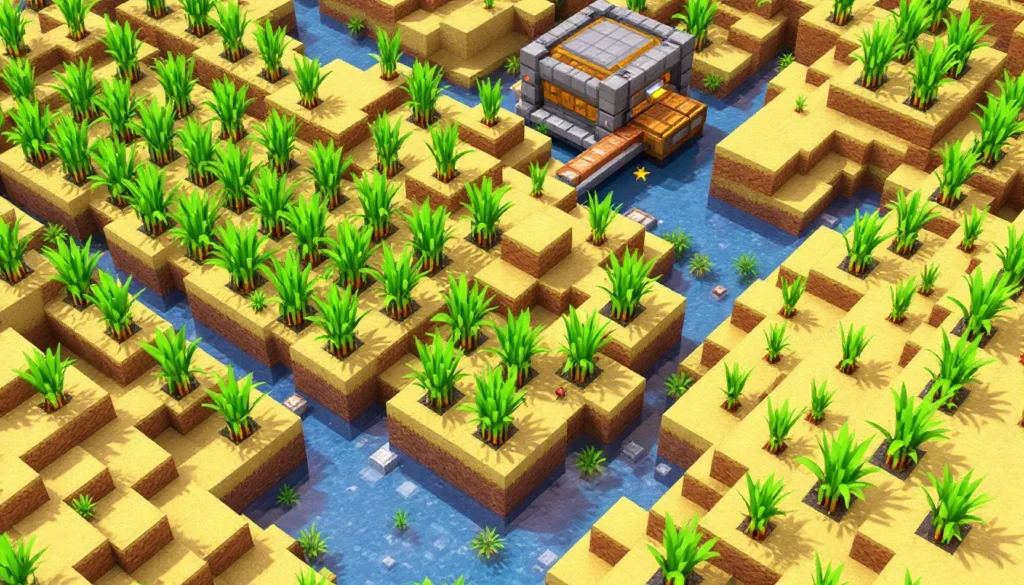
The most basic sugar cane farm requires almost zero materials: find a river, lake, or dig a small pond. Plant sugar cane along the water’s edge, leaving space between each plant for growth inspection. This design requires no redstone knowledge and can be set up within the first Minecraft day.
For maximum simplicity:
- Dig a 1-block-deep trench 10-20 blocks long
- Fill the trench with water (one bucket at the end creates a water source that flows)
- Plant sugar cane on both sides of the water trench
- Harvest the top two blocks when they reach maximum height
The riverside farm scales poorly but serves early game needs. Players can gather 50-100 sugar cane per harvest cycle, enough for initial book production and minor trading. Expect to harvest manually every 15-30 minutes of active gameplay for consistent yields.
Efficient Row-Based Layout
Once players have access to basic building materials, upgrading to a row-based layout dramatically improves harvest efficiency. This design uses parallel water channels with sugar cane planted in rows, creating clear pathways for movement and collection.
Optimal row-based design:
- Create alternating rows of water and planting blocks (sand or dirt work best)
- Make water rows 1 block wide, planting rows 2 blocks wide
- Extend rows 15-20 blocks in length for manageable harvesting
- Build 5-10 parallel rows for substantial output
This pattern allows players to walk between planting rows, harvesting both sides without trampling crops or awkward jumps. A 10-row farm with 20-block length provides 400 sugar cane plants, yielding 600-800 sugar cane per harvest when properly maintained.
The row-based layout also prepares the foundation for future automation. The regular spacing and water placement transition smoothly into observer-based or piston systems when players acquire redstone components. Many players who engage with various farm automation projects start with this manual layout before upgrading to mechanical harvesting.
Semi-Automatic Sugar Cane Farms
Observer-Based Piston Harvester
The observer-piston design represents the sweet spot between manual labor and complex redstone. When sugar cane grows to the third block, an observer detects the growth and triggers a piston that breaks the top two blocks. This preserves the bottom block for continuous regrowth without replanting.
Core components for a single-column observer farm:
- 1 observer facing the sugar cane growth space
- 1 sticky piston positioned to push horizontally into the sugar cane
- 2 redstone dust (or a direct observer-to-piston connection)
- Water channel, planting block, and sugar cane
The observer watches the air block where the third sugar cane segment would grow. When growth occurs, the observer outputs a redstone pulse that activates the piston. The piston extends, breaking the sugar cane, then retracts. Broken sugar cane items drop and can be collected manually or via hopper systems.
This design works on both Java and Bedrock editions with identical behavior. The main limitation is noise, observers and pistons create sound with each activation, making large farms near bases potentially annoying.
Materials and Step-by-Step Build Instructions
Building a 10-column observer farm requires:
- 10 observers
- 10 sticky pistons
- 10 sugar cane (for initial planting)
- 10 sand or dirt blocks
- Water source blocks (5-10 depending on layout)
- 10-20 hoppers (optional, for item collection)
- 1 chest
Step-by-step construction:
-
Dig the foundation: Create a trench 1 block deep, 10 blocks long. Place water source blocks every 4 blocks to create a flowing water channel.
-
Place planting blocks: On one side of the water, place 10 sand or dirt blocks at the same level as the water surface.
-
Plant sugar cane: Place one sugar cane on each planting block.
-
Position observers: Behind each planting block, place an observer at ground level, facing toward the sugar cane. The observer’s “face” (the side with the red dot) should point at the air block above the sugar cane.
-
Install pistons: One block above each observer, place a sticky piston facing toward the sugar cane growth area. The piston should align to push into the second block of grown sugar cane.
-
Redstone connections: Connect each observer’s output (the opposite side from the face) to its corresponding piston using redstone dust or direct contact.
-
Collection system: Below the planting blocks, dig one layer down and place hoppers feeding into a central chest. This collects broken sugar cane automatically.
The farm activates whenever any sugar cane reaches three blocks tall. For players seeking efficiency across multiple automation projects, similar observer-piston mechanics apply to iron production systems and other resource farms.
Fully Automatic Sugar Cane Farm Designs
Zero-Tick Farm Design (Java Edition)
Important note: Zero-tick farms were patched in Java Edition 1.16. As of 2026, they don’t function in current versions. But, older worlds running pre-1.16 versions or modified servers can still use these designs.
Zero-tick exploitation forced sugar cane to grow instantly by manipulating block updates. The design used pistons to move the planting block in and out of position, triggering rapid growth cycles. At peak efficiency, zero-tick farms produced 10-20 times more sugar cane than natural growth farms.
Players on current versions should skip zero-tick designs entirely. They’ve been replaced by flying machine harvesters and observer-based farms that respect vanilla growth mechanics.
Flying Machine Harvester System
Flying machine harvesters represent the pinnacle of automatic sugar cane farming in modern Minecraft. These contraptions use slime block or honey block flying machines that traverse a rail or predefined path, breaking sugar cane with pistons as they move.
The basic concept involves:
- A flying machine that moves horizontally along a sugar cane farm
- Pistons mounted on the flying machine that extend and break sugar cane at the second block height
- A collection system (water streams and hoppers) that gathers broken items
- A redstone clock or player-activated button that launches the flying machine
Building a functional flying machine harvester requires intermediate-to-advanced redstone knowledge. The machine must travel the entire farm length, break all sugar cane, then either reset automatically or require manual repositioning. Many players reference detailed guides for complex farm mechanics when first attempting flying machine designs.
Material requirements for a 20-block flying harvester:
- 12-16 slime blocks or honey blocks
- 4-6 observers
- 4-6 sticky pistons
- 2-4 regular pistons
- Redstone blocks (3-5)
- Building blocks (20-30 for framing)
- Hoppers and chests for collection
The advantage over static observer farms is scalability. A single flying machine can harvest hundreds of sugar cane plants in one pass, then automatically return to start position. Production rates easily exceed 10,000 sugar cane per hour in optimized setups.
Bedrock Edition Automatic Farm Differences
Bedrock Edition handles redstone differently than Java, creating unique challenges and opportunities for automatic farms. Quasi-connectivity doesn’t exist in Bedrock, meaning many Java Edition designs break when transferred directly.
Key Bedrock differences:
- Observers have different update detection patterns
- Piston behavior varies slightly, especially with slime block contraptions
- Redstone dust power transmission follows different rules
- Hopper collection speeds differ (Bedrock hoppers transfer items faster)
The most reliable Bedrock automatic design uses a simplified observer-piston array with water collection streams. Instead of flying machines, Bedrock players typically expand observer-piston columns horizontally and vertically, creating massive static farms.
A proven Bedrock design:
- Build 50-100 observer-piston columns in a grid pattern
- Place water source blocks above the farm that flow down through collection channels
- Install hoppers beneath collection points feeding into chest arrays
- Use item sorters if mixing multiple farm types in one collection system
This brute-force approach sacrifices elegance for reliability. Since Bedrock redstone behaves more consistently (less prone to update order bugs), large static farms run smoothly without the tick-perfect timing required in some Java designs. Players interested in expanding their automated resource generation often combine sugar cane farms with other systems, learning techniques applicable to modded farming setups and custom resource packs.
Maximizing Your Sugar Cane Farm Efficiency
Optimizing Farm Layout and Spacing
Farm efficiency isn’t just about automation, layout and spacing dramatically affect yield per square block. The most efficient designs maximize sugar cane plants while minimizing water blocks and walking distance.
Optimal spacing patterns:
- Checkerboard water placement: One water source block hydrates a 9×9 area (80 planting spaces with 1 water block)
- Diagonal planting: Increases plant density but complicates harvesting and piston placement
- Vertical stacking: Multiple farm layers at different Y-levels multiply output without expanding horizontal footprint
For observer-piston farms, maintain consistent spacing between columns. Pistons require one block of clearance to extend, and observers need direct line-of-sight to growth blocks. A common mistake is cramming components too tightly, causing redstone interference or blocked piston arms.
Vertical farms exploit Minecraft’s build height. Stack 4-5 identical farm layers from Y=64 to Y=100, each with its own collection system. Use water elevators or dropshafts to transport items to a central storage area. This design quintuples output while occupying the same chunk footprint.
Chunk loading matters for AFK farms. Sugar cane only grows in loaded chunks, areas within render distance of a player. For farms to operate while players work elsewhere, position the farm within spawn chunks (always loaded) or use chunk loaders on modded servers.
Bone Meal and Growth Speed Considerations
As mentioned earlier, bone meal doesn’t work on sugar cane. Players coming from crop farming might waste bone meal attempting to speed growth, it produces no effect whatsoever.
Growth speed optimization focuses on maximizing the number of plants rather than accelerating individual growth. A farm with 1,000 plants at normal speed vastly outproduces a farm with 100 plants, regardless of per-plant growth rate.
Theoretical growth rates:
- Average time for sugar cane to grow one block: 18 minutes (in ideal conditions)
- Time to reach maximum 3-block height: 36 minutes from planting
- Expected harvests per real-world hour with AFK farming: 1.5-2 full harvests
Some players explore randomTickSpeed modification via commands (/gamerule randomTickSpeed). The default value is 3: increasing to 10-15 dramatically speeds growth but impacts server performance and game balance. Most survival servers and vanilla worlds leave this at default.
For legitimate growth acceleration, focus on farm scale. A 20×20 farm with 300 sugar cane plants produces more in one hour than a 5×5 farm produces in a full day, even if both use identical harvesting systems.
Common Sugar Cane Farm Mistakes to Avoid
Planting on the wrong blocks: Sugar cane only grows on dirt, grass, sand, red sand, podzol, and moss blocks. Planting on stone, netherrack, or other blocks fails immediately. Double-check block type before building large farms.
Diagonal water placement: Water must be directly adjacent (sharing an edge) with planting blocks. Diagonal water doesn’t hydrate sugar cane. This catches players who assume water works like crop hydration, where diagonal placement is valid for wheat and carrots.
Breaking the bottom block: During manual harvesting, breaking the bottom sugar cane block destroys the entire plant. Always harvest from the top down, leaving the bottom block intact for regrowth. Observer-piston farms automate this by targeting the second block.
Insufficient collection systems: Automatic farms produce items faster than players realize. Without proper hopper networks or water collection streams, items despawn after 5 minutes. A farm generating 100 sugar cane per minute wastes 50% of production if collection can’t keep pace.
Redstone interference: Placing multiple observer-piston columns too close together can cause redstone cross-talk, where one observer triggers neighboring pistons. Maintain at least 2-block spacing between redstone components, or use redstone repeaters to isolate signals.
Ignoring chunk boundaries: Large farms that span multiple chunks may experience partial operation if chunks unload. The 20×20 grid represents a reasonable size for single-chunk farms (chunks are 16×16, but overlap allowances work for slightly larger builds).
Flying machine collision: In flying machine harvesters, the machine itself must have a clear return path. Players often build beautiful farms but forget to account for machine reset, leading to stuck harvesters that require manual repositioning.
Bedrock Edition design imports: Copying Java Edition designs to Bedrock without modification results in non-functional farms 80% of the time. Redstone mechanics differ enough that designs require platform-specific testing. Always verify a design matches your edition before investing materials.
What to Do with Your Sugar Cane Harvest
Crafting Paper and Books
Paper remains the primary use for sugar cane. Three sugar cane converts to three paper at a crafting table. Paper then combines with leather to create books (three paper + one leather = one book).
The numbers scale quickly:
- One bookshelf requires three books (nine paper, three leather)
- A full enchanting setup needs 15 bookshelves (135 paper, 45 leather)
- Lecterns for librarian villagers need four books each (12 paper per lectern)
Beyond enchanting, maps require eight paper plus one compass. Cartography tables duplicate maps using one map plus one paper, making paper essential for exploration and map rooms. Players building large-scale map art projects consume thousands of paper for blank map creation.
Librarian villager trading offers the best renewable return on paper. Novice-level librarians trade 24 paper for one emerald. Master-level librarians offer enchanted books in exchange for books and emeralds. A single automatic sugar cane farm can sustain multiple librarian villagers for infinite emerald generation.
Making Sugar for Potions and Food
One sugar cane converts to one sugar at a crafting table. While less efficient than paper conversion, sugar has unique uses that justify dedicated production:
- Fermented spider eye: Sugar + brown mushroom + spider eye creates a potion ingredient for weakness and harming effects
- Pumpkin pie: Pumpkin + egg + sugar makes a food item that restores 8 hunger points
- Cake: Milk buckets + sugar + egg + wheat produces a placeable food block
For potion brewing, sugar enables indirect creation of potions of harming and weakness, critical for converting zombie villagers or creating splash potions for PvP. The quantities needed are modest compared to paper consumption, but having a steady sugar supply prevents mid-brewing material shortages.
Sugar also trades with cartographer and wandering trader villagers, though the exchange rates favor paper trading through librarians. Some players maintain separate sugar stockpiles for brewing while converting the bulk of harvests to paper for enchanting operations.
Conclusion
Sugar cane farming in Minecraft scales from dirt-simple riverside plantings to complex flying machine harvesters that operate while you’re exploring the End. The progression mirrors typical Minecraft gameplay: start with manual harvesting to meet immediate needs, upgrade to observer-piston semi-automation when redstone becomes available, then build fully automatic systems once you’ve mastered slime block mechanics.
The designs covered here work across Java and Bedrock editions as of early 2026, though always test redstone contraptions in creative mode before committing materials in survival. Meta shifts are rare for sugar cane, growth mechanics have remained stable since the game’s early versions, but redstone changes in major updates can affect automatic farm reliability.
Whether you’re stockpiling paper for a massive enchanting library or feeding librarian villagers for emerald trading, a well-designed sugar cane farm pays dividends for hundreds of hours. Build once, harvest forever.