Building a pirate ship in Minecraft isn’t just another construction project, it’s a statement. Whether anchored off a jungle coast or dominating the skyline above a fortress, a well-crafted pirate vessel transforms any world from ordinary to legendary. With the game’s constant evolution through updates like the Trails & Tales expansion and beyond, players in 2026 have more tools than ever to create authentic, functional, and downright intimidating ships.
This guide covers everything from planning your first schooner to rigging advanced redstone cannons on a full-scale man-o’-war. Builders working in both Survival and Creative modes will find step-by-step instructions, design inspiration, and pro tips to avoid the common pitfalls that turn dream ships into floating disasters. Let’s set sail.
Table of Contents
ToggleKey Takeaways
- A well-designed pirate ship in Minecraft transforms from a simple build into a functional base, faction hub, or adventure map centerpiece with proper planning and execution.
- Choose your pirate ship size carefully: sloops suit beginners (2-4 hours), brigantines work for intermediate builders (6-10 hours), and galleons demand advanced skills (15-30+ hours).
- The hull is the foundation of any pirate ship build—establish a centered keel, create curved ribs, and maintain proper waterline proportions to avoid structural imbalance.
- Pirate ship builds gain immersion through layered details: functional interiors, realistic rigging, decorative elements like figureheads and barrels, and a signature banner at the highest mast point.
- Avoid common mistakes when building your pirate ship by maintaining proper mast-to-hull proportions, adding curvature to sails, using aged wood types, and keeping interior lighting practical for gameplay.
Why Build a Pirate Ship in Minecraft?
Pirate ships offer something most builds don’t: they’re mobile in concept, functional in design, and instantly recognizable. A castle might impress, but a galleon with billowing sails and cannons aimed at the horizon tells a story.
From a gameplay perspective, pirate ships serve multiple roles. In Survival mode, they function as floating bases with storage, farms, and living quarters all contained within a defensible perimeter. On multiplayer servers, they’re perfect for faction wars, treasure hunts, and roleplay scenarios. Creative builders use them as centerpieces for adventure maps or as part of larger harbor builds that showcase technical skill.
The aesthetic appeal is undeniable. The contrast of dark oak against white concrete sails, the vertical challenge of mast construction, and the satisfaction of nailing those curved hull lines, it’s a build that demands respect. Plus, unlike static structures, ships feel alive. They belong on water, cutting through waves (even if those waves don’t actually move), ready to chase loot or flee danger.
Pirate ships also scale beautifully. Beginners can tackle a simple sloop in an afternoon, while veterans might spend weeks perfecting a triple-masted flagship with working interior decks, functional cannons, and custom figureheads. The skill ceiling is high, but the entry point is accessible.
Planning Your Pirate Ship Build
Choosing the Right Ship Size and Style
Size determines everything: build time, material cost, and where the ship can actually fit. Here’s the breakdown by ship type:
Sloop (Small):
- Dimensions: 20-30 blocks length, 8-12 blocks width
- Masts: Single mast
- Best for: Beginners, Survival mode early builds, tight harbors
- Build time: 2-4 hours
Brigantine (Medium):
- Dimensions: 35-50 blocks length, 12-18 blocks width
- Masts: Two masts
- Best for: Intermediate builders, multiplayer faction bases
- Build time: 6-10 hours
Galleon (Large):
- Dimensions: 55-80+ blocks length, 18-25 blocks width
- Masts: Three or more masts
- Best for: Advanced builders, Creative showcase builds
- Build time: 15-30+ hours
Style matters too. Classic pirate vessels lean heavily on dark oak, spruce, and stripped logs for that weathered look. Fantasy variants might incorporate prismarine for ghostly effects or end stone for a corrupted aesthetic. Modern interpretations can use concrete and terracotta for cleaner lines, though purists will argue this breaks immersion.
Decide early whether the ship needs to be functional (actually floatable if using mods) or purely decorative. This affects block choices, glass panes look great but don’t convey the weight of a real ship the way solid blocks do.
Selecting the Perfect Location and Materials
Location dictates visibility and context. Deep ocean biomes provide unlimited space but make Survival builds tedious due to constant swimming. Coastal builds near existing bases offer convenience and integration with existing infrastructure. Rivers and lakes work for smaller ships but limit mobility for larger vessels.
For maximum impact, consider these spots:
- Natural harbors: Coves with cliff backdrops create dramatic anchoring points
- Island chains: Multiple ships can form a pirate fleet
- Underwater bases: Position the ship above a hidden stronghold
- Desert coastlines: The contrast between sand and ship draws the eye
Essential materials for a medium brigantine:
- Wood: 2,000-3,000 dark oak planks (hull), 800-1,200 spruce planks (deck)
- Logs: 400-600 stripped dark oak logs (structural beams)
- Wool/Concrete: 600-900 white blocks (sails)
- Fences: 200-300 dark oak fences (railings, rigging)
- Slabs/Stairs: 800-1,200 various wood slabs and stairs (detailing)
- Decorative: 100+ blocks of chain, lanterns, barrels, chests, trapdoors
In Survival, gathering materials is the real grind. A tree farm with at least 50 dark oak saplings planted in 2×2 configurations will sustain hull construction. For sails, sheep farms provide wool, but concrete requires sand and gravel, plan accordingly. Many builders underestimate decorative block needs: those lanterns, barrels, and trapdoors add up fast.
Step-by-Step Guide to Building a Pirate Ship
Creating the Hull and Base Structure
The hull is everything. Get this wrong and the entire ship looks off, no matter how good the details are.
Start with the keel, the central spine running bow to stern. For a 45-block brigantine, place a single line of dark oak planks as your centerline. This is your reference point.
Building the hull (bottom-up approach):
-
Establish width: At the widest point (usually 60% back from the bow), mark the beam width using temporary blocks. For a 15-block-wide ship, that’s 7 blocks out from center on each side.
-
Create ribs: Build vertical frames every 5-7 blocks using fences or temporary scaffolding. These define the curve from keel to deck.
-
Shape the bow: The front should taper aggressively. Use stairs and slabs to create the angled prow. Upside-down stairs work well for the waterline curve.
-
Shape the stern: The rear can be rounded (galleon style) or squared off (merchant style). Rounded sterns require more stairs and slabs but look more authentic.
-
Fill the hull: Connect the ribs with planks, maintaining the curve. The hull should bulge at the waterline and taper toward the deck.
Pro tip: Build one half of the hull completely, then mirror it block-for-block to the other side. Asymmetry kills the look faster than any other mistake.
The waterline should sit 3-4 blocks below the main deck for proper proportions. Too high and it looks like a bathtub toy: too low and it seems half-sunk.
Constructing the Deck and Ship Levels
Once the hull is solid, the deck becomes your workspace.
Main deck construction:
- Use spruce planks or dark oak planks for contrast against the hull
- Leave a 1-block border around the edge for railings
- Incorporate trapdoors in horizontal position for grating effects over cargo holds
- Add stair blocks at level changes for a worn, realistic feel
Most ships have 2-3 internal levels:
-
Lower deck/cargo hold: Below the waterline, accessed by ladder. Use barrels, chests, and item frames with paper (maps) for decoration.
-
Main deck: The operational space with helm (steering wheel), masts, and working areas.
-
Upper deck/poop deck: Elevated stern section for the captain’s quarters and navigation.
Create access between levels using ladders or stair blocks in the ship’s interior. Hatches made from trapdoors separate levels and add realism.
Railings are critical for safety and aesthetics. Use dark oak fences along all open deck edges. Place lanterns or torches every 4-5 blocks for lighting and detail. Some builders alternate fence posts with walls for a chunkier, more substantial rail.
Building Masts, Sails, and Rigging
Masts make or break the silhouette. They need to be tall enough to dominate but proportional to the hull.
Mast construction for a two-masted brigantine:
Mainmast (taller, positioned forward of center):
- Height: 25-30 blocks above deck
- Base: 2×2 stripped dark oak logs
- Crow’s nest: At 20 blocks up, build a 5×5 platform using fences and slabs
Mizzenmast (shorter, rear position):
- Height: 20-25 blocks above deck
- Base: 2×2 stripped dark oak logs
- Offset 10-15 blocks behind mainmast
Yards (horizontal crossbeams):
- Use dark oak fences extending 8-12 blocks on each side of the mast
- Position 2-3 yards per mast at different heights
- Angle them slightly using stair blocks at the ends for dynamic look
Sails:
White wool or white concrete forms the sail body. Many players following detailed build tutorials use banner patterns for custom sail designs, skulls, stripes, or faction symbols.
For billowing sails (the curved, wind-filled look):
- Build the sail flush against the yard initially
- Extend it forward 1-2 blocks at the center to create bulge
- Use slabs and stairs at the edges to soften the rectangular shape
- Add fences or chains connecting sails to the deck as rigging
Rigging adds complexity without much material cost. Run chains or fences from:
- Mast tops to bow and stern (stays)
- Yard ends down to deck edges (shrouds)
- Between masts (cross-rigging)
Don’t overdo it, too much rigging creates visual clutter. Aim for suggestion rather than literal accuracy.
Adding the Captain’s Quarters and Interior Rooms
Interiors separate good builds from great ones. They’re optional in Creative showcases but essential for Survival functionality.
Captain’s quarters (stern, upper deck):
- Bed placed against the stern wall
- Enchanting table with bookshelf setup for max-level enchants
- Chest with ender chest for valuables
- Desk made from trapdoors and fences
- Windows using glass panes with shutters (trapdoors on sides)
- Carpet in red or purple for luxury
Crew quarters (lower deck, forward):
- Multiple beds in bunks (place beds with blocks above for stacked look)
- Shared chests for storage
- Brewing stand for potions
- Furnace or smoker for cooking (place carefully to avoid fire)
Galley/kitchen (mid-deck):
- Cauldron for water
- Campfire (place trapdoor above to prevent accidental damage)
- Barrels for food storage
- Composter for disposal
Armory (lower deck, mid-ship):
- Armor stands displaying diamond/netherite gear
- Item frames with weapons
- Smithing table and grindstone
Light everything with lanterns rather than torches, they look period-appropriate and don’t clutter walls. Sea lanterns hidden under carpets or behind blocks provide ambient light without visible sources.
Customizing Your Pirate Ship with Details
Essential Pirate Ship Decorations and Features
Details transform a wooden hull into a living ship. These elements require minimal resources but maximum impact:
Bow features:
- Figurehead: Use player heads, carved pumpkins, or build a small dragon/serpent from stairs and slabs
- Anchors: Two vertical chains dropping from the bow into the water
- Bowsprit: Extended platform jutting forward, made from fences and slabs
Deck equipment:
- Ship’s wheel: Place a fence with trapdoors arranged in cross pattern around it
- Cannons: Use end rods or lightning rods as barrels, mounted on stairs or slabs for carriages. Space them every 6-8 blocks along the hull
- Barrels and crates: Cluster in corners, lashed down with fencing
- Coiled rope: Use brown carpet or brown terracotta in spiral patterns
Flags and banners:
- Main flag: At the highest mast point, use banner with custom pattern
- Jolly Roger: Skull and crossbones pattern on black banner
- Faction colors: Multiple smaller banners along rigging
Weathering effects:
- Mix stripped logs with regular planks for aged wood
- Add mossy cobblestone or andesite to lower hull for barnacle effect
- Place vines sparingly on stern for abandoned/ghost ship aesthetic
- Use oxidized copper blocks or warped wood for cursed variants
Functional additions:
- Map room: Table made from slabs with item frames containing filled maps
- Brig/prison: Small cell with iron bars in the lower deck
- Treasure room: Hidden space accessed through piston door, filled with gold blocks and chests
Advanced Redstone Mechanisms for Your Ship
Redstone brings pirate ships to life, especially on multiplayer servers where function matters.
Working cannons (TNT launcher):
- Build cannon from dispensers facing outward through hull
- Load with TNT and fire charges
- Connect to button or lever with redstone
- Add observer block for automatic reload systems
- Use water streams below deck to prevent hull damage
Retractable gangplank:
- Build plank from sticky pistons (3-5 blocks)
- Wire to lever inside ship
- Extends for boarding, retracts for defense
- Use slabs on top of pistons for smooth walkway
Hidden treasure compartments:
- Place chest in floor or wall
- Cover with sticky piston and matching block
- Trigger with hidden button behind painting or item frame
- Add hopper below chest for additional security layers
Lighthouse beacon (for nighttime navigation):
- Build beacon on tallest mast point
- Use sea lantern or glowstone core
- Surround with glass for containment
- Wire to daylight sensor for automatic night activation
Alarm system (PvP servers):
- Place tripwire hooks at gangplank entrance
- Connect to note blocks below deck
- Set different tones for different entry points
- Alerts crew to boarders
For builders seeking advanced mechanisms, community resources at dedicated modding platforms offer schematics for rotating turrets, working rudders with slime block engines, and even self-propelling ships using TNT duplication glitches (though these break on most servers).
Popular Pirate Ship Design Ideas and Themes
Classic Galleon and Brigantine Designs
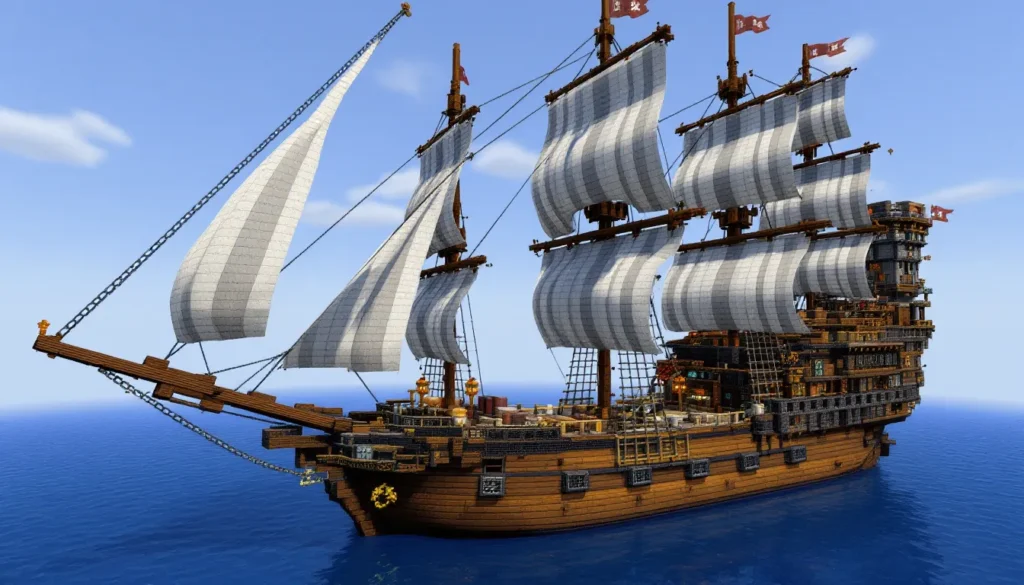
The Spanish galleon remains the gold standard. Three or four towering masts, ornate stern castle with windows and balconies, and a pronounced forecastle create the iconic profile. Use white concrete or quartz for trim against dark oak hulls. The stern should feature multiple stories with large windows, glass panes in arch formations work best.
Key galleon features:
- High forecastle (raised bow section) 3-4 blocks above main deck
- Elaborate stern with captain’s balcony extending outward
- Gun decks with 12-20 cannons per side
- Complex rigging with 4-6 sails per mast
Brigantine designs prioritize speed over firepower. Sleeker hulls, only two masts, and lower profile make them look fast even when stationary. Use jungle wood or acacia for more exotic variants suggesting ships from distant waters.
British man-o’-war variants emphasize military function: rows of cannon ports (use trapdoors painted with black concrete behind), Union Jack banners, and squared-off sterns. These work great for naval battle scenarios on servers.
Ghost Ships and Haunted Vessel Builds
Ghost ships tap into Minecraft’s darker aesthetic options.
Spectral materials:
- Soul sand and soul soil for decks (creates slow-walk effect)
- Bone blocks for hull structure
- Soul lanterns and soul campfires for eerie blue lighting
- Cobwebs throughout rigging and interior
- Phantom membranes in item frames as tattered sail pieces
Weathering techniques:
- Leave holes in hull and deck, deliberate gaps suggest battle damage
- Use gravel or coarse dirt scattered on deck (debris)
- Mix stone brick variants (cracked, mossy) into wooden structure
- Place skeleton skulls on spikes (fences) as warnings
Undead crew:
- Armor stands positioned at helm, cannons, and deck
- Dress in leather armor dyed gray/white
- Add skeleton skulls to stands using carved pumpkin mechanic
- Use invisible item frames for weapons they’re “holding”
Floating ghost ships work well over land. Build the ship 20-30 blocks in the air, supported by cloud-like formations of white wool or white concrete powder. Add chains hanging down as if the ship broke free from anchor.
Flying Pirate Ships and Fantasy Variants
Airships blend pirate aesthetics with steampunk or fantasy elements.
Steampunk airship:
- Replace sails with balloons made from large wool spheres
- Add copper blocks (various oxidation states) for mechanical details
- Use blast furnaces, smokers, and furnaces as visible engines
- Chains and iron bars for suspended hull beneath balloon
- Redstone lamps as running lights
- Pistons as decorative machinery
Fantasy variants:
- End stone and purpur for dimension-hopping corsair
- Prismarine and sea lanterns for underwater/Atlantean vessel
- Nether brick and blackstone for demon ship from the Nether
- Cherry wood (from 1.20+) for Eastern-inspired junk ship
Dragon-powered ships feature carved dragon heads at the bow and stern, built from prismarine stairs and slabs for scales. Add dragon head blocks (from End ships) as figureheads. Wings made from black concrete and purple stained glass can extend from the hull.
Ice ship builds use packed ice, blue ice, and frosted ice for a frozen ghost ship aesthetic. Pair with powder snow for deck coverage and ice spikes jutting from the hull.
Using Pirate Ships in Survival and Creative Mode
Survival mode integration:
A pirate ship minecraft build in Survival serves as more than decoration, it’s a mobile (conceptually) fortress.
Defensive positioning:
- Anchor ship 30-40 blocks offshore to prevent mob spawning
- Build dock with drawbridge (piston-extended walkway)
- Install iron golems on deck as crew/security
- Light interior completely to prevent hostile spawns
Resource functionality:
- Kelp farm beneath ship in surrounding water
- Fishing station at stern with AFK fish farm setup
- Villager trading hall in lower decks (transport via minecart or boat)
- Guardian farm if positioned over ocean monument
Travel hub:
- Nether portal hidden in cargo hold for fast travel
- Ender chest network for resource access
- Elytra launcher from crow’s nest for aerial deployment
Creative mode showcase:
Creative builds can ignore practical limits. Build entire fleets, reconstruct historical battles, or create floating cities of connected ships.
Fleet composition:
- 1 flagship (massive galleon)
- 2-3 escort frigates (medium size)
- 4-5 sloops (small, quick builds)
- 1-2 merchant vessels (wider, cargo-focused)
Position ships in formation, line of battle, convoy escort pattern, or harbor scene with docked vessels.
Integrating Your Ship into Adventure Maps and Roleplay
Adventure map integration:
Pirate ships excel as adventure map setpieces. Many creators featured on gaming guide sites use them for:
- Boss arenas: Multi-level combat on deck and interior
- Puzzle dungeons: Players solve redstone puzzles to unlock treasure rooms
- Spawn points: Players begin shipwrecked or as new crew
- Objective locations: Capture the ship, defend against waves, or escape before it sinks (using falling block mechanics)
Command block integration:
/summonzombie pigmen as undead pirates/fillcommands for gradual sinking effect/particlefor cannon smoke and magical effects/playsoundfor creaking wood, ocean ambience, cannon fire
Roleplay server usage:
On roleplay servers, ships become trade vessels, naval faction bases, or pirate hideouts. Establish rules for ship-to-ship combat (TNT cannons with repair time limits), cargo runs (chest boats with valuable items), and territory control (ships mark claimed waters).
Crew roles:
- Captain (ship owner, decision maker)
- Quartermaster (inventory manager, distributes loot)
- Navigator (plans routes using maps)
- Gunner (operates cannons during PvP)
- Carpenter (repairs damage post-battle)
- Lookout (scouts from crow’s nest)
Use Discord integration or in-game books for ship logs, documenting voyages and battles.
Common Mistakes to Avoid When Building Pirate Ships
Proportion failures:
The biggest error is scale inconsistency. Masts too short make the ship look stubby. Hull too narrow creates a kayak instead of a vessel. Follow the rule: mast height should equal 80-100% of ship length for proper proportions.
Too much symmetry:
Perfect symmetry looks sterile. Real ships have minor asymmetries, add rope coils on one side only, cluster barrels unevenly, let details breathe. The hull itself should be perfectly mirrored, but deck clutter shouldn’t be.
Flat sails:
Rectangular wool blocks hanging from yards look like flags, not sails. Always add curvature using stairs and slabs at edges. The sail should bulge forward at the center as if catching wind.
Wrong wood choices:
Birch and oak planks make ships look like playgrounds. Stick to dark oak, spruce, and jungle wood for authentic aging. Acacia works for fantasy variants only.
Overdetailing:
Packing every block with detail creates visual noise. Ships need breathing room, large sections of clean planking balance ornate areas like the stern castle or figurehead.
No waterline consideration:
Building a ship that sits entirely above water or sinks too deep kills the illusion. The waterline should cut across the hull’s widest point, with 30-40% of hull depth below water.
Ignoring interior lighting:
Dark interiors are unusable in Survival and look unfinished. Lanterns, sea lanterns hidden under carpets, or glowstone behind decorative blocks maintain atmosphere while preventing mob spawns.
Rigging overload:
Some builders go crazy with chains and fences, turning the ship into a spiderweb. Rigging should suggest complexity without obscuring the masts and sails. Less is more.
Forgetting the flag:
Every pirate ship needs a banner at the highest point. It’s the signature, the identifier. Don’t skip this final touch.
Building on land:
Ships look wrong on land unless deliberately dry-docked. If building in Survival away from water for safety, plan to move it via WorldEdit/MCEdit or rebuild at final location. The context matters.
Best Mods and Texture Packs for Pirate Ship Builds
Recommended mods (Java Edition):
Archimedes’ Ships/Valkyrien Skies (1.19+):
Makes ships actually sail. Place a ship helm block, right-click to convert the structure into a movable entity. Ships can navigate water, and with Valkyrien Skies, they handle realistically with physics-based movement. Game-changing for Survival pirate roleplay.
Create Mod (1.18+):
Allows mechanical propulsion systems, build working paddle wheels, steam engines, and rotating cannons. The mod’s rotational power system lets you create functioning ship machinery that looks incredible in motion.
Conquest Reforged (1.12.2):
Adds thousands of decorative blocks perfect for ship detailing, realistic rope coils, hanging rigging, proper cannons, and authentic nautical equipment. The block variety makes builds look professional-grade.
Small Ships (1.19+):
Adds craftable boats that function as mobile entities with inventory. While not full pirate ships, they’re great for escort boats or ship’s launches.
Dynamic Surroundings (all versions):
Adds ocean wave sounds, wind audio, and weather effects that make seaside ship builds far more immersive.
Texture packs:
John Smith Legacy (128x-512x):
Medieval/fantasy aesthetic perfect for pirate ships. Wood textures look aged and weathered, rope appears in fence connections, and the overall palette matches pirate theme.
Conquest of the Sun (32x):
Companion to Conquest Reforged, works with vanilla too. Adds connected textures that make plank walls look like proper ship hull panels instead of individual blocks.
Mizuno’s 16 Craft (16x):
Maintains vanilla feel but adds subtle depth and detail. Good for players who want enhancement without dramatic art style change.
Flows HD (64x-128x):
Realistic water textures that actually look like ocean waves. Essential for ship screenshots.
Bare Bones (16x):
Simplified, clean aesthetic that makes ships look like hand-drawn illustrations. Unique style perfect for stylized builds.
Shader packs (for screenshots/video):
BSL Shaders: Balanced performance with excellent water reflections and dynamic lighting
Complementary Shaders: Enhanced shadows make mast rigging pop
SEUS PTGI: Ray-tracing quality if your hardware can handle it, ships at sunset look photographic
Vanilla Plus: Lightweight shader that adds atmosphere without FPS murder
When recording ship tours or taking portfolio screenshots, enable shaders, set time to sunset (red/orange sky), and position camera at water level to emphasize scale.
Conclusion
Building a pirate ship in Minecraft is a rite of passage for builders who want to prove their skills. It tests proportions, detailing, and spatial reasoning in ways that flat builds never will. Whether you’re anchoring a modest sloop off your Survival base or constructing a legendary flagship for a Creative server, the principles remain the same: respect the hull curve, let the masts soar, and fill the details with personality.
The pirate ship minecraft community continues to evolve. Updates introduce new blocks (bamboo wood variants, hanging signs, chiseled bookshelves) that offer fresh detailing options. Mods push the boundaries of what’s possible, making ships that actually sail or even fly between dimensions.
Start small if you’re new, a single-masted sloop teaches the fundamentals without overwhelming time commitment. Once you’ve mastered hull curves and sail placement, scale up to brigantines and galleons. And remember: the best pirate ships are the ones that tell a story. Is it a cursed ghost vessel? A admiral’s flagship? A scrappy corsair that’s seen better days? Let that narrative guide your block choices, and the ship will feel alive long after the last plank is placed.
Now grab your oak logs, chart your course, and start building. The seas are waiting.