Churches have been Minecraft staples since the game’s early days, whether you’re roleplaying on a medieval server, building a village centerpiece, or just want that towering cathedral to dominate your skyline. But there’s a massive gap between slapping together four cobblestone walls and crafting something that actually makes other players stop and screenshot.
This guide breaks down everything from small chapel builds you can finish in an afternoon to sprawling Gothic cathedrals that’ll take weeks. You’ll get block-by-block instructions, material lists, design principles that actually matter, and advanced techniques for builders ready to level up. Whether you’re working in Survival mode with limited resources or going wild in Creative, you’ll walk away knowing exactly how to turn that church concept into a build worth showing off.
Table of Contents
ToggleKey Takeaways
- A Minecraft church build can scale from a simple afternoon chapel (15×20 blocks) to a sprawling Gothic cathedral (50×80+ blocks), so choose your style and size based on your skill level and available time.
- Master vertical construction, symmetry, and arches through church building—techniques that directly transfer to castles, towers, and other ambitious Minecraft structures.
- Strategic lighting using chandeliers, wall sconces, and candles (especially sea lanterns hidden behind stained glass) creates atmospheric ambiance that transforms the interior at night.
- Flying buttresses, ribbed vaults, and cruciform floor plans define authentic Gothic cathedral designs, while modern churches emphasize clean lines, concrete, and minimalist lighting instead.
- Always create a temporary dirt mockup of your church’s footprint and height before building to check sightlines and prevent placement mistakes that waste resources in Survival mode.
- WorldEdit commands like //copy, //paste, and //hcyl drastically reduce building time and eliminate repetitive labor on large structures like symmetrical facades and rounded apses.
Why Build a Church in Minecraft?
Churches aren’t just decorative, they serve real functions in Minecraft worlds that go beyond aesthetics. In multiplayer servers, they become natural gathering points for community events, weddings, memorials, or roleplay sessions. On survival worlds, a church often anchors village builds, giving your settlement that lived-in, purposeful feel that random houses can’t achieve.
From a building skill perspective, churches force you to master vertical construction, symmetry, and decorative detailing. You’ll learn to work with arches, spires, and interior lighting, techniques that translate to castles, towers, and basically any ambitious build. The challenge scales perfectly too. A simple wooden chapel teaches fundamentals, while a full Gothic cathedral with flying buttresses will test even veteran builders.
There’s also the creative satisfaction of adapting real-world architecture into Minecraft’s blocky constraints. Translating Romanesque rounded arches or Gothic pointed windows into 1×1 meter cubes requires problem-solving that makes you a better builder overall. Plus, churches photograph incredibly well for screenshots and video content, those tall spires and detailed facades just hit different against a sunset shader.
Planning Your Minecraft Church Build
Choosing the Right Church Style and Architecture
Three main styles dominate Minecraft church builds, each with distinct block palettes and difficulty curves. Medieval/Romanesque churches use thick stone walls, rounded arches, and modest towers, think early European village churches from 800-1200 AD. These work great in survival mode since they rely heavily on cobblestone, stone bricks, and oak wood.
Gothic cathedrals step up the complexity with pointed arches, ribbed vaults, massive stained glass windows, and those iconic flying buttresses. You’ll need a wider block palette: various stone brick variants, dark oak, spruce, and plenty of glass panes. The vertical emphasis means these builds shoot skyward, plan for heights of 40-80 blocks minimum.
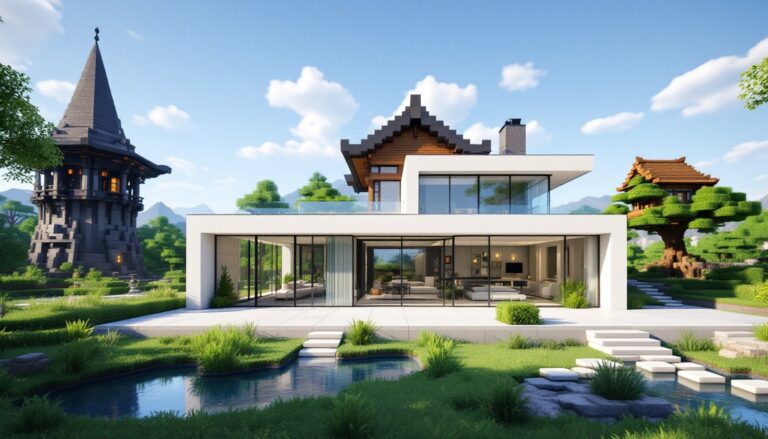
Modern churches flip the script with clean lines, flat or angular roofs, and lots of concrete and glass. Quartz, white concrete, light gray concrete, and huge glass panels define this style. They’re often wider than tall and work beautifully in contemporary city builds.
Pick your style based on your world’s aesthetic, available materials, and honest assessment of your building skills. Don’t start with a 200-block-tall Gothic monster if you’ve never built arches before.
Selecting the Perfect Location and Size
Location dictates everything. For village churches, pick a central elevated spot, slightly higher than surrounding buildings but not on a mountain. You want it visible from multiple angles without towering awkwardly. Flat or gently sloping terrain saves hours of terraforming.
Size depends on context and ambition. A small church (15×20 blocks footprint, 20-30 blocks tall) fits village scales and takes 2-4 hours in Creative, longer in Survival. A medium church (25×40 footprint, 40-60 tall) serves as a town centerpiece and demands 8-15 hours. Large cathedrals (50×80+ footprint, 60-100 tall) are multi-session projects requiring 20-50+ hours and serious material stockpiles.
Always build a dirt or wool mockup first. Place temporary blocks to outline the footprint and tower heights. Walk around it. Check sightlines from your base or nearby builds. This 10-minute step prevents the soul-crushing realization that your church blocks someone’s farm view or looks cramped between existing structures.
Gathering Essential Materials and Blocks
Material requirements vary wildly by style, but here’s a baseline shopping list for a medium medieval church:
- Stone bricks: 8,000-12,000 blocks (main walls, arches)
- Cobblestone/Andesite: 3,000-5,000 (foundation, accents)
- Oak/Dark Oak planks: 2,000-3,000 (roof, interior)
- Oak/Spruce logs: 500-800 (structural beams, detailing)
- Glass panes: 400-800 (windows)
- Stone brick stairs/slabs: 1,500-2,500 (roofing, arches)
- Stone brick walls: 200-400 (decorative details)
For Gothic builds, add smooth stone, polished andesite, dark oak wood, and significantly more glass, those massive stained glass windows aren’t cheap. Budget 1,000-2,000 glass panes for a proper rose window alone.
Modern churches swap most stone for concrete. Expect 6,000-10,000 white concrete, 2,000-4,000 light gray, and 3,000-5,000 glass blocks for that minimalist aesthetic.
In Survival, set up dedicated material farms early. Stone brick production alone can bottleneck your build for days. Villager trading for glass becomes essential once you’re placing hundreds of panes.
Step-by-Step: Building a Small Medieval Church
Constructing the Foundation and Floor
Start with a 15×20 block rectangular foundation using cobblestone or andesite, this creates visual weight and distinguishes the base from walls. Dig down 1-2 blocks if you want a slight raised platform, filling with your foundation material and adding stone brick stairs as a step-up around the perimeter.
For the floor, stone bricks work as the main material with a pattern. Lay them in a standard grid, then replace every 4th block in both directions with polished andesite or smooth stone to create a subtle checkerboard. This adds visual interest without overwhelming the space. The floor should sit 1 block above the surrounding terrain or level with it, avoid sinking your church into the ground unless it’s a crypt-style build.
Mark your doorway location on the short end (3 blocks wide, centered) and where your altar will sit on the opposite end. These anchor points guide everything else. Many builders skip this planning step and end up with off-center entrances that haunt them forever.
Building the Walls and Windows
Walls use stone bricks as the primary block, rising 12-15 blocks high for proper interior space. At each corner, substitute stone brick walls or cobblestone walls for 1-2 blocks to create pilaster effects, these vertical accents break up flat surfaces.
Windows start at 3 blocks above the floor. For medieval style, make them 2 blocks wide and 4-5 tall, using glass panes with stone brick stairs (placed upside-down) as pointed arch tops. Space windows 3-4 blocks apart along side walls. The front facade gets a larger window above the door, 3 wide and 6 tall works, framed with full stone brick blocks and stair arches.
Add horizontal detailing at mid-height using a ring of stone brick slabs or stairs around the entire building. This cornice line adds shadow depth and breaks the visual climb. Use oak wood planks or logs as corner accents if you want a half-timbered look, though pure stone reads more traditionally medieval.
Creating the Roof and Steeple
The roof should overhang walls by 1 block on all sides. Use dark oak wood stairs or stone brick stairs arranged in a steep pitch, medieval churches rarely have shallow roofs. Build from the edge upward, creating a peaked roof that meets at a central ridgeline. Top the ridge with cobblestone walls or stone brick walls for that classic peaked detail.
For the steeple, choose front-center or back-center placement. Build a 3×3 tower rising 8-12 blocks above the main roof using the same stone brick material. At the top, create a pointed spire using cobblestone walls or fences stacked vertically, topping with an iron fence or end rod as a cross.
Alternatively, build the tower as 5×5 for the first 4 blocks, then step in to 3×3 for the upper section. This creates a tiered effect that looks more complex without much extra effort. Add small 1-block windows on each tower face using single glass panes, these “bell tower” openings are authentic and provide lighting breaks.
How to Build a Large Cathedral in Minecraft
Designing the Grand Layout and Pillars
Cathedrals demand a cruciform (cross-shaped) floor plan to hit that authentic Gothic vibe. Start with a 30×60 block nave (the main hall), then add a 50-block-wide transept crossing perpendicular at about the 40-block mark. This creates the cross shape when viewed from above. The apse (semicircular end section) extends another 10-15 blocks past the transept on the altar end.
Interior pillars are non-negotiable for cathedrals, they carry the visual weight and enable the soaring heights. Place 5×5 pillar bases using stone bricks every 10 blocks down the nave, creating a colonnade. Build pillars up to 20-25 blocks height, then add stone brick arches connecting adjacent pillars. These arches should be 5-7 blocks wide using stairs and slabs to create the curved underside.
The outer walls rise even higher, 30-40 blocks minimum. This height differential between the nave roof and outer walls creates space for clerestory windows (upper-level windows that flood cathedrals with light). Anyone who’s attempted a multiplayer server cathedral knows coordinated building at this scale gets complicated, but the payoff is worth it.
Adding Stained Glass Windows
Gothic cathedrals live and die by their stained glass. For a proper rose window, mark a circle 15-20 blocks in diameter on your front facade (use online circle generators for perfect curves). The outer ring uses stone brick walls or iron bars to create the stone tracery framework. Fill sections with different colored stained glass in geometric patterns, blue, red, yellow, and purple create classic Gothic palettes.
Side windows should be lancet style: tall (8-12 blocks), narrow (2-3 blocks wide), topped with pointed arches made from stairs. Many builders reference real cathedral images when mixing glass colors. A common pattern: blue and red alternating in vertical bands, with yellow borders and purple accents.
Pro tip: Place sea lanterns or glowstone behind stained glass, hidden in the wall cavity. This makes windows glow at night without visible light sources, a technique that modding communities have expanded with shader-compatible blocks. The interior illumination effect transforms the build after sunset.
Building Towers, Spires, and Flying Buttresses
Twin towers flanking the entrance are cathedral staples. Build them as 9×9 or 11×11 structures rising 50-70 blocks. Use the same stone brick palette but add decorative breaks: switch to chiseled stone bricks for a ring every 10 blocks, insert balcony outcroppings at mid-height using slabs, and create narrow arched windows spiraling upward.
Spires cap the towers. Transition from square tower to pointed spire using stone brick stairs arranged in increasingly smaller tiers, creating an octagonal transition, then a pointed pyramid. Top with end rods or lightning rods as crosses. Alternatively, use cobblestone walls stacked vertically for a thinner, more elegant spire that extends another 15-20 blocks skyward.
Flying buttresses are the Gothic signature move, exterior arches that appear to support the walls. Build 5-block-tall pillars 6 blocks away from your outer wall, then connect them to the wall at the 25-block height using stone brick arches (3-4 blocks wide). The arch should span the gap gracefully using stairs and slabs. Add a stone brick slab cap to the outer pillar with a small pyramid top. Repeat every 12-15 blocks around the cathedral’s perimeter.
Interior Design Ideas for Your Minecraft Church
Pews, Altars, and Ceremonial Spaces
Pews establish instant church vibes. Use dark oak wood stairs facing forward in rows, spaced 2 blocks apart with a center aisle at least 4 blocks wide. Each row should extend 8-12 blocks toward the walls, leaving 2-block walking space on the sides. Place oak wood pressure plates or carpets in the aisles to define pathways.
The altar sits on a raised platform at the apse end, build it 2-3 blocks higher than the main floor using stone brick stairs as steps. Center a lectern or enchantment table (representing the holy text) on a stone brick platform. Flank with armor stands holding banners or skeleton skulls on iron bars as candelabras. Add campfires (with haybales underneath to increase smoke) in iron bars cages as incense burners.
For a baptismal font, use a cauldron filled with water, surrounded by a low stone brick wall (1 block high) near the entrance. Many roleplay servers use these as functional respawn points, adding gameplay utility to the decoration.
Lighting Techniques for Atmospheric Ambiance
Chandeliers are non-negotiable for proper church lighting. Suspend oak wood fences from the ceiling using more fences as chains, creating a hanging framework 4×4 blocks wide. Attach lanterns or sea lanterns to the bottom corners and center. Space multiple chandeliers down the nave every 12-15 blocks for even coverage without visible light seams.
Wall sconces add side lighting. Place iron bars or oak wood fences against walls, with lanterns or torches attached. For more elaborate designs, create recessed alcoves (1-2 blocks deep) with lighting inside, this prevents light sources from jutting awkwardly into walkways.
Candles (added in Minecraft 1.17+) revolutionized church builds. Place clusters of 3-4 white candles on stone brick slabs around the altar and along window sills. They provide subtle lighting that reads as authentic without the harsh glow of torches. Combine with soul lanterns in darker corners for that bluish, ethereal accent light.
Avoid putting torches everywhere like a cave system. Churches should have pools of light and shadow, strategic under-lighting creates drama that flat illumination kills.
Decorative Details and Religious Symbolism
Banners as tapestries transform blank walls. Craft white banners and use a loom to create cross patterns (white cross on red field, or vice versa), then hang them on pillars and behind the altar. Many builders create custom banner designs representing different in-game factions or server groups.
Paintings strategically placed near the entrance or in side chapels add color breaks without major building. The larger 4×4 paintings work best, though you’ll need to place and break them repeatedly to cycle to preferred images.
Statues require more skill but elevate the build significantly. A simple approach: use stone or quartz blocks to create a 3-4 block tall humanoid figure in an alcove, add a player head at the top, and frame the niche with stone brick walls. For more detail, builders who’ve mastered detailed creation techniques often incorporate armor stands posed mid-prayer.
Floor mosaics add interest to large open spaces. Use different colored concrete, terracotta, or wool to create geometric patterns or religious symbols in the nave floor. Common designs include crosses, quatrefoils (four-lobed symmetrical shapes), or radial patterns emanating from the center aisle.
Alternative Church Styles and Creative Variations
Modern Church Designs
Contemporary churches ditch ornamentation for bold geometry and material honesty. White concrete and light gray concrete form the base palette, with glass comprising 40-60% of exterior walls. Instead of spires, use angular or flat roofs with dramatic overhangs, cantilevered sections extending 3-4 blocks beyond walls using concrete slabs create striking shadow lines.
Asymmetrical layouts replace traditional cruciform plans. Try an L-shaped footprint, or a circular sanctuary with a separate rectangular entrance tower. Quartz blocks and smooth stone substitute for concrete if you’re building in versions before 1.12 or prefer the slightly warmer tone.
Lighting goes minimalist: recessed sea lanterns in floors or ceilings rather than chandeliers, and end rods as thin vertical accents. The altar becomes a simple white concrete platform with a single lectern, no clutter, maximum negative space. Many builders incorporate water features using glass channels in floors or exterior reflecting pools.
Japanese Temple and Eastern Architecture
Japanese temple architecture offers a completely different aesthetic that still functions as worship space. Use dark oak wood and spruce wood as primary materials, with red concrete or red terracotta for accent walls (representing vermillion lacquer on real temples).
Pagoda-style roofs are the defining feature, wide, curved overhangs with upturned corners. Build each roof tier using stairs (dark oak or spruce) extending 2-3 blocks beyond walls, with corners lifting up via stairs placed at 45-degree angles. Stack 2-4 roof tiers with progressively smaller footprints above: start with a 25×25 base, then 20×20, then 15×15.
Add stone lanterns using cobblestone walls as posts with stone brick slabs as caps, placing lanterns or soul lanterns inside. Bamboo forests as landscaping and cherry blossom trees (bone meal on cherry saplings in 1.19+) complete the aesthetic. Interior design uses tatami mats (light gray or yellow concrete arranged in rectangular patterns) and minimal furniture, just the altar with incense and candles.
Fantasy and Custom Church Builds
Break realism entirely for fantasy worlds. Prismarine and dark prismarine create underwater or ocean-themed churches, perfect for guardian-worshipping cults on aquatic servers. Nether brick and blackstone churches suit dark fantasy or demon-worship themes, add crying obsidian and soul lanterns for extra edge.
End stone brick churches fit interdimensional or cosmic themes. These work surprisingly well when combined with purpur blocks and magenta stained glass. For builders chasing the most unique aesthetics, searching through community designs on gaming inspiration sites reveals wild concepts like mushroom churches (huge mushroom blocks) or ice churches (packed ice, blue ice, with blue stained glass).
Floating churches suspended via chains or seemingly impossible cantilevers create instant visual hooks. Build the main structure, then suspend it 20-30 blocks in the air using chains connected to hidden supports, or use invisible block exploits in Creative for truly gravity-defying architecture. These work especially well as build centerpieces that players can see from across the map.
Advanced Building Techniques and Pro Tips
Using WorldEdit and Building Mods
WorldEdit transforms church builds from week-long grinds into manageable projects. The //copy and //paste commands handle symmetrical elements, build one side of your facade, copy it, flip it, and paste for instant mirror symmetry. For towers, build one, copy it, then //move to the opposite side rather than rebuilding from scratch.
//hcyl (hollow cylinder) generates rounded apses and tower bases instantly. Command syntax: //hcyl stone_bricks 15 30 creates a 15-block-radius hollow cylinder, 30 blocks tall, perfect for cathedral apses. Combine with //sphere for dome roofs that would take hours to build manually.
The //replace command speeds up material changes. Built your entire cathedral in stone brick but want the base in andesite? Select the bottom 5 layers and //replace stone_bricks andesite, done in seconds.
For survival builds, building mods like Schematica or Litematica let you load blueprints as overlays, showing exactly where to place each block. Build the church once in Creative, save the schematic, then load it as a ghost image in your Survival world. It’s not cheating, it’s efficient planning.
Incorporating Redstone Features
Automated bell systems add interactive elements. Wire a bell to a redstone clock circuit to ring every few minutes, or connect it to a button at the entrance so visitors can announce their arrival. For time-based ringing, use a daylight sensor to trigger bells at sunrise/sunset, appropriate for roleplay servers with scheduled events.
Hidden lighting creates dramatic reveals. Bury redstone lamps behind stained glass windows, connected to a lever in a hidden room. Flip it to illuminate all windows simultaneously from inside, useful for ceremonies or screenshots. Combine with note blocks tuned to bell sounds for a full audio-visual package.
Automatic doors feel anachronistic but improve multiplayer functionality. Use pressure plates inside and outside the entrance, connected to sticky pistons that retract door blocks. For medieval aesthetics, use iron doors with hidden pressure plates under carpet or stone pressure plates that blend into stone brick floors.
Some builders install item frame collection boxes near altars, with hoppers underneath collecting donations (items players leave). Connect a comparator to detect when items are deposited, triggering a short redstone lamp flash or note block ding as acknowledgment, small touches that make the build feel alive.
Best Minecraft Church Design Inspiration and Downloads
Planet Minecraft hosts thousands of church schematics ranging from humble chapels to Notre Dame recreations. Filter by version compatibility, style tags (Gothic, Modern, Medieval), and rating to find quality builds. Most uploads include schematic files for WorldEdit or Litematica, plus screenshots from multiple angles.
Minecraft Structure Planner (web tool) lets you browse pre-made structures with 3D rotation and block-by-block layer views. Particularly useful for understanding how builders achieved specific roof curves or arch geometries. You can examine each horizontal slice separately, making it easier to translate complex builds into your own world.
YouTube build tutorials from creators like Fwhip, GeminiTay, and BdoubleO100 break down church construction in real-time. Watching how experienced builders approach proportions, detailing, and common problem areas (like getting steeple transitions right) teaches techniques that text guides can’t convey. Most include downloadable world files in video descriptions.
For ultra-realistic recreations, the Conquest Reforged mod includes hundreds of church-specific blocks: proper stone tracery, authentic medieval tiles, carved capitals, etc. Many showcase builds use this to achieve near-photorealistic results. Even if you’re building in vanilla, studying these constructions reveals where to place detail and what shapes to aim for with standard blocks.
Reddit’s r/Minecraftbuilds community holds weekly build contests often featuring religious structures. Browsing top posts from the past year shows current meta techniques and popular style trends. Comment sections frequently include build breakdowns and block palette lists, essentially free coaching from builders who’ve already solved the problems you’re facing.
Conclusion
Church builds in Minecraft hit that sweet spot between technical challenge and creative expression, enough structure to guide your planning, enough freedom to make it yours. Whether you’ve built a simple village chapel or committed to a months-long cathedral project, the techniques you’ve learned transfer directly to castles, towers, and basically any ambitious structure.
The real beauty is that church builds improve with iteration. Your third church will demolish your first in quality as you internalize proportions, master arch construction, and develop your own detailing shortcuts. Don’t stress perfection on build #1.
Start with a style that matches your skill level and available materials. Test designs in Creative before committing resources in Survival. Reference real architecture but don’t be enslaved by it, Minecraft’s constraints demand creative adaptation. And most importantly, build what excites you. That enthusiasm shows in the final result more than any technique guide can teach.