When Minecraft launched in 2009, nobody expected a blocky, bearded character with a blank stare to become one of gaming’s most recognizable faces. Yet here we are, Steve’s pixelated mug has transcended the game itself, spawning countless memes, Halloween costumes, and even a spot on the Super Smash Bros. roster. His face isn’t just a character design: it’s a cultural phenomenon that encapsulates everything Minecraft represents: simplicity, creativity, and accessibility.
What makes Steve’s face so memorable? It’s not technical prowess or hyper-realistic rendering. It’s the opposite. With just a handful of pixels, Mojang created a character that gamers worldwide could project themselves onto while simultaneously laughing at. The minecraft steve face has become shorthand for the entire sandbox experience, a testament to how minimalist design can achieve maximum impact. Whether you’re building your first dirt hut or recreating the Sistine Chapel in blocks, Steve’s unchanging expression watches over it all with the same neutral determination.
Table of Contents
ToggleKey Takeaways
- Steve’s iconic blocky face proves that minimalist character design can achieve maximum cultural impact, transcending the game itself through memes, costumes, and gaming recognition.
- Born from technical necessity in early Minecraft, the minecraft steve face uses just 64 pixels arranged with precision to create a universally recognizable character design that works at any scale.
- Steve’s ambiguous features—simple cyan eyes, debated beard/smile, and neutral expression—allow players to project their own emotions onto the character, making it a versatile blank canvas.
- The character’s simple 8×8 pixel face texture democratized Minecraft’s modding scene by making custom skin creation accessible to anyone with basic image editing skills.
- Steve’s placement in Super Smash Bros. Ultimate in 2020 cemented his status as a legitimate gaming icon alongside Mario and Link, proving indie game characters can achieve legendary status.
- The minecraft steve face influenced entire game design philosophies, demonstrating that default player characters can become iconic rather than forgettable, reshaping how developers approach customization systems.
The Origins of Steve’s Blocky Face
Steve wasn’t always called Steve. When Markus “Notch” Persson first developed Minecraft, the default player character had no official name. The community referred to him as “Player” or simply “the guy,” until around 2011 when Notch offhandedly mentioned the name Steve in a tweet. The name stuck, and Mojang eventually made it official.
The face itself was born from necessity rather than deliberate artistic vision. Early Minecraft ran on minimal resources, and Notch needed a character model that would render quickly across different systems. The result was an 8×8 pixel face texture mapped onto a blocky head, about as simple as character design gets. Those 64 pixels would go on to become more recognizable than characters with million-polygon budgets.
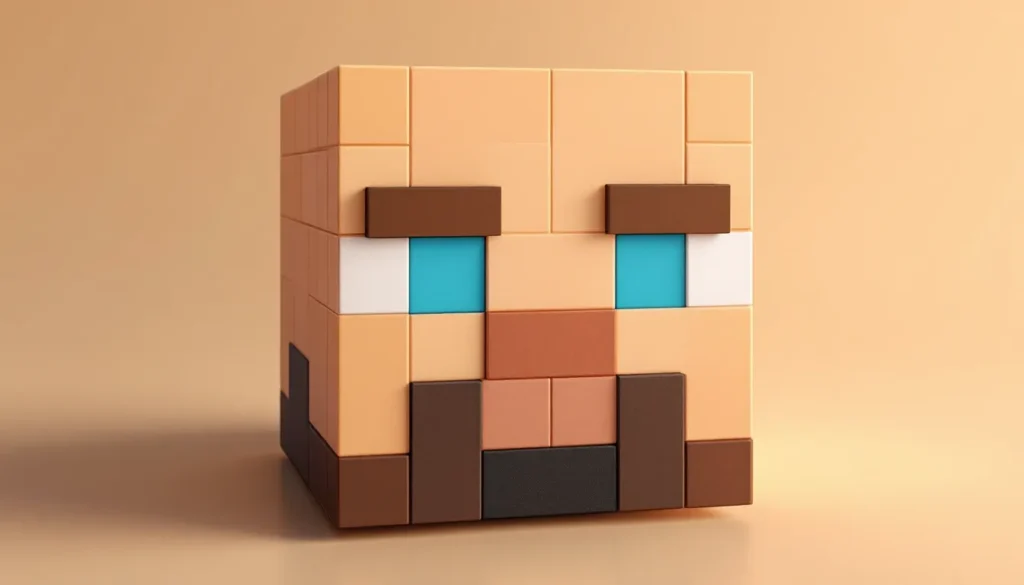
Notch drew inspiration from the chunky, low-poly aesthetics of early 3D games, but he pushed minimalism further. Steve’s face features just a few dark pixels for eyes, a slightly darker patch suggesting a nose and mouth area, and what the community affectionately calls a “beard”, though whether it’s facial hair or just a badly defined smile remains hotly debated among fans. This ambiguity became part of the character’s charm.
The technical constraints that shaped Steve’s appearance also democratized Minecraft’s modding scene. Because the skin system used such simple textures, anyone with basic image editing skills could create custom skins. This accessibility transformed Steve from a fixed character into a template, a blank canvas that players could make their own while still maintaining that distinctive blocky silhouette.
Why Steve’s Face Became a Gaming Icon
The Minimalist Design Philosophy
Steve’s face works because it follows the “less is more” principle to its logical extreme. Those eight pixels contain just enough information to register as a face without prescribing a specific emotion or personality. It’s the visual equivalent of a neutral game state, players fill in the emotional blanks based on what they’re doing in-game.
This minimalism also made Steve instantly readable at any scale. Whether you’re looking at your character from first-person, watching someone else play from across the room, or seeing Steve’s face on a tiny mobile screen, those features remain identifiable. Compare that to more detailed character designs that lose clarity when scaled down, and you understand why Steve’s simplicity became a strength.
The blocky aesthetic also aligned perfectly with Minecraft’s core gameplay loop. Everything in Minecraft is made of cubes, so having a cubic-headed protagonist feels thematically consistent. Steve doesn’t fight against the game’s visual language, he embodies it. His face became synonymous with the entire voxel-based building experience.
Game developers have since recognized this approach’s value. Many successful indie games now embrace minimalist character design, understanding that players don’t need photorealism to connect with a character. Steve proved that iconic design transcends polygon count.
Cultural Impact and Meme Status
Steve’s face exploded beyond Minecraft shortly after the game’s viral success around 2011-2012. The distinctive square head and simple features made it perfect meme material, easy to recognize, easy to recreate, and absurd enough to be funny. Image macros featuring Steve’s deadpan expression commenting on various situations flooded social media.
The “Minecraft Steve” Halloween costume became a phenomenon unto itself. Those cardboard box heads with Steve’s face printed on them started appearing in stores by 2013, and they’ve remained popular ever since. Kids and adults alike don costumes that reduce the human head to a literal cube, all to embody this character. The costume’s popularity speaks to Steve’s cultural penetration, people who’ve never played Minecraft still recognize that face.
YouTube and Twitch culture amplified Steve’s status exponentially. As Minecraft content dominated gaming platforms, Steve’s face became the avatar for an entire genre of content. Thumbnails featuring exaggerated or distorted versions of Steve’s face became standard practice for Minecraft YouTubers trying to stand out in a crowded field.
By the time Steve joined Super Smash Bros. Ultimate as a playable fighter in 2020, his evolution from indie game protagonist to legitimate gaming icon was complete. Nintendo doesn’t just hand out Smash roster spots, characters need cultural significance and fan demand. Steve earned his place alongside Mario, Link, and Pikachu, cementing his face among gaming’s true legends.
Breaking Down Steve’s Face: Every Pixel Explained
The Eyes: Simple Yet Expressive
Steve’s eyes are arguably the most important feature on his face, consisting of just two 2×2 pixel squares in a cyan-blue color (#2a3e4c in hex). These four pixels per eye convey surprising amounts of expression through context alone. When Steve mines, those eyes stare with determination. When he falls into lava, those same pixels suddenly look panicked.
The eyes sit slightly above center on the face texture, positioned where human eyes would naturally fall on a head. This anatomical accuracy, even though the extreme abstraction, helps our brains process the arrangement as a face rather than random pixels. The spacing between them follows roughly the “one eye width apart” rule that artists use, maintaining facial proportion even at this resolution.
Interestingly, Steve’s eyes have no pupils, whites, or any internal detail. They’re solid blocks of color, yet players consistently describe them as “looking” in various directions depending on context. This is pure psychological projection, our brains are so tuned to reading faces that we impose expression onto the simplest arrangements of features.
The eye color itself was a deliberate choice. That muted teal-blue stands out against the peachy skin tone without being aggressively bright. It’s visible but not cartoonish, maintaining the semi-realistic aesthetic Notch aimed for even though the low resolution.
The Nose, Mouth, and Beard Details
The lower half of Steve’s face is where things get contentious. A darker brown patch (#4c3e2a) occupies roughly the bottom third of his face, and the community has debated its meaning for over a decade. Is it a beard? A smile? A goatee? Poor shading? The answer: probably all of the above.
What appears to be a nose consists of a slightly darker vertical strip of pixels in the center of the face. It’s subtle enough that some players don’t even register it as a distinct feature. This restraint prevents Steve from looking like a caricature, the nose suggests depth without demanding attention.
The mouth area is even more ambiguous. Some pixels in the beard/smile region are slightly lighter, potentially indicating teeth or an open mouth. But the resolution is so low that it reads more as texture than as a definitive facial expression. This ambiguity became crucial to Steve’s versatility, players see whatever expression fits their current situation.
Many modding communities have created alternate interpretations of Steve’s lower face, from clean-shaven versions to elaborate mustaches. These modifications prove how much interpretation exists in those few pixels. Change just two or three pixels, and Steve can look cheerful, grumpy, or completely different while maintaining his essential Steve-ness.
The face texture also includes subtle shading around the edges that suggests dimension on the flat cube head. Darker pixels on the sides create the illusion of shadow, helping the head read as three-dimensional rather than a flat surface. It’s economical design at its finest, every pixel serves a purpose.
How to Recreate Steve’s Face in Different Contexts
Creating Steve’s Face in Minecraft (Pixel Art)
Building Steve’s face as pixel art inside Minecraft itself has become a rite of passage for players learning creative mode. The process requires planning, material gathering, and understanding how blocks translate to pixels.
Start by choosing your canvas location, flat ground works best for beginners. You’ll need approximately 16×16 blocks to create a recognizable Steve face with good detail. Map out your design first using graph paper or a pixel art tool. Each block represents one pixel from Steve’s original texture.
For materials, you’ll want:
- Skin base: Light-colored blocks like birch planks, sandstone, or bone blocks
- Eyes: Cyan terracotta or warped planks match Steve’s eye color well
- Beard/mouth: Dark oak planks or brown terracotta capture the darker lower face
- Shading: Mix in gray concrete or stone variants for depth
Build from bottom to top, working in horizontal rows like printing an image. Count carefully, one misplaced block throws off the entire proportion. Many players build a frame first to ensure their dimensions stay consistent. If you’re building vertically on a wall rather than flat on the ground, the process remains the same but requires scaffolding.
Advanced builders create 3D versions with the face protruding from a cubic head structure, though this requires significantly more blocks and spatial planning. Redstone enthusiasts have even built animated Steve faces using pistons and block-swapping mechanisms.
Drawing Steve’s Face: Step-by-Step Guide
Drawing Steve’s face works best with graph paper or a digital art program with a visible grid. The blocky, pixelated nature actually makes it easier than drawing realistic faces, you’re working with discrete units rather than smooth curves.
Begin with an 8×8 grid, this matches Steve’s original face resolution. If you want more detail, scale up to 16×16 or 32×32, maintaining the same pixel patterns but with more refined edges.
Step-by-step process:
- Fill your entire grid with a base skin tone (peachy-beige)
- Add the eyes in row 3, centered horizontally, two 2×2 squares of cyan-blue with one square spacing between them
- Create the nose by darkening a 1-pixel-wide vertical line down the center, starting below the eyes
- Fill the bottom third with dark brown for the beard/mouth area
- Add subtle shading on the sides and top by darkening pixels slightly
- Optional: add highlights to the eyes with lighter pixels for extra dimension
For a more stylized approach, some artists enlarge specific features or exaggerate the blockiness. Gaming news sites like IGN frequently feature fan art that reimagines Steve with various art styles while maintaining his core features. The key is keeping those recognizable elements, the blue eyes, the beard, the square head, even if you’re adding your own twist.
Digital artists working in programs like Photoshop or Procreate should disable anti-aliasing to maintain sharp pixel edges. Use the pencil tool rather than brushes to ensure clean, blocky shapes. Many artists create Steve in vector format to allow infinite scaling without quality loss.
3D Modeling and Printing Steve’s Face
Steve’s cubic design translates beautifully to 3D printing. His face consists entirely of flat planes and 90-degree angles, no organic curves to troubleshoot. Even beginners can successfully print a recognizable Steve head.
For 3D modeling, programs like Tinkercad or Blender work well. Start with a 8x8x8 unit cube for the head. The face texture can be applied as a UV map if you’re rendering digitally, or you can model the features as separate geometric insets for painting after printing.
If you’re creating a wearable Steve head for cosplay:
- Scale the head to approximately 12-14 inches per side for adult wear
- Hollow out the interior, leaving at least 0.2-inch wall thickness
- Cut eye holes that align with Steve’s eyes for visibility
- Add ventilation holes on sides or top
- Consider splitting the model into multiple prints if your printer bed is too small
For printing the face details, you have two options: print the entire head in one color and paint the features afterward, or use multi-color printing with filament changes at specific layers. The painting approach gives you more control over colors but requires steady hands and patience.
Painting recommendations:
- Use acrylic paints for PLA or PETG prints
- Apply a primer coat first for better paint adhesion
- Use painter’s tape to mask off sections for clean color boundaries
- Seal with a matte varnish to protect the paint and reduce gloss
Some makers create modular Steve heads where the face is a separate printed panel that snaps into the head cube. This allows easy face swapping for different expressions or custom designs.
Customizing Steve’s Face: Skins and Modifications
Using Custom Skins to Change Steve’s Appearance
Minecraft’s skin system democratized character customization long before battle passes and cosmetic stores dominated gaming. Players can completely change Steve’s appearance by uploading a new 64×64 pixel texture file, including radically altering his face.
To change your skin in Java Edition, visit the official Minecraft website, log into your account, and navigate to the profile section. Upload your custom skin file (PNG format), and it’ll appear in-game after reloading. Bedrock Edition handles skins through the in-game marketplace or by importing custom skins on PC and mobile versions.
When designing a custom face for your skin, you’re working with the same 8×8 pixel face area Steve uses. The texture file’s head section occupies the top-left portion, with front, sides, top, and back all mapped onto the cube. Many players modify just the face while keeping the rest of Steve’s body, creating familiar-yet-different characters.
Popular face modifications include:
- Expression changes: Adding smiles, frowns, or surprised looks
- Accessories: Glasses, masks, or face paint
- Different features: Changing eye color, adding scars, or removing the beard
- Character mashups: Combining Steve’s body with faces from other games or media
Tools like Minecraft skin editors make the process accessible even for non-artists. These web-based applications let you paint directly onto a 3D preview of your character, seeing changes in real-time from all angles. Advanced editors include layers, undo/redo, and preset features you can drag and drop.
The outer layer system introduced in later Minecraft versions allows 3D accessories like hats, hair, or masks to extend beyond the base head cube. This means faces can now have elements that protrude, beard pixels that float slightly off the face, glasses that stand away from the eyes, or hair that adds volume. These outer layer pixels use the same texture file but occupy different coordinates, doubling the available detail.
Popular Steve Face Variations in the Community
The Minecraft community has produced countless Steve face variations over the years, some becoming almost as iconic as the original. These variations often reflect gaming trends, memes, or player creativity.
Derp Steve emerged early in Minecraft’s history, a deliberately poorly-drawn version with misaligned eyes and a crooked smile. What started as a joke became its own meme, representing chaotic or incompetent gameplay. Some players adopt Derp Steve skins specifically for comedic Let’s Play videos.
Herobrine, while technically not Steve, uses his face as a base with one crucial change: solid white eyes with no pupils. This creepypasta character became so widespread that Mojang still includes “Removed Herobrine” in patch notes as an ongoing joke. The face modification is minimal, just recoloring a few pixels, but the effect is dramatically different.
Realistic Steve attempts surfaced around 2013-2015, with artists rendering Steve’s blocky features as an actual human face. The results ranged from hilarious to nightmare fuel, but they highlighted how much interpretation exists in those simple pixels. These realistic versions appeared in videos, artwork, and even unofficial merchandise.
Steve with different expressions became popular as players wanted more personality. Angry Steve (furrowed brow, gritted teeth), Happy Steve (big smile, closed eyes), and Sad Steve (downturned mouth, teary eyes) all maintain Steve’s essential features while conveying specific emotions. These work particularly well for multiplayer servers where players want their avatars to reflect their personalities.
Crossover Steve skins combine his iconic face with elements from other games or media. Steve wearing Master Chief’s helmet but keeping his face visible underneath, or Steve with Sonic’s blue coloring but maintaining those distinctive eyes. These mash-ups celebrate both Minecraft’s culture and players’ other gaming interests.
Steve’s Face in Popular Culture and Merchandise
From Costumes to Collectibles
Steve’s face has spawned an entire merchandise ecosystem that extends far beyond the game itself. Walk into any gaming retailer, and you’ll find Steve’s blocky visage staring back from t-shirts, mugs, bedding, backpacks, and lunch boxes. The face’s simple geometry makes it perfect for mass production, no complex curves or gradients to reproduce.
The cardboard Steve head masks became a cultural phenomenon starting around 2013. What began as DIY craft projects evolved into officially licensed products sold worldwide. These full-head boxes perfectly replicate Steve’s cubic dimensions and funny face details, letting fans literally become the character. The masks appear at gaming conventions, birthday parties, and Halloween with reliable frequency.
Figma and other collectible manufacturers have produced articulated Steve figures that treat his blocky design as an aesthetic choice rather than a limitation. These figures feature Steve’s face printed with remarkable accuracy even though the scale, proving the design’s versatility. Limited edition variants with different facial expressions or accessories have become collector’s items.
LEGO’s official Minecraft line embraced Steve’s design completely, translating his pixelated face onto minifigure heads. This crossover made perfect sense, both properties celebrate blocky building and creative construction. The LEGO Steve face manages to feel both like a LEGO minifig and authentic to Minecraft, a design challenge that could’ve easily failed.
Apparel featuring Steve’s face ranges from subtle (small embroidered logos) to absurdly literal (full-body suits that turn the wearer into a walking Steve). The face works at any size and on any material because its bold, high-contrast features remain readable whether shrunk to an inch or blown up to poster size.
Steve in Super Smash Bros. and Beyond
Steve’s inclusion in Super Smash Bros. Ultimate in October 2020 represented a watershed moment for both the character and indie gaming in general. Nintendo’s crossover fighter typically features characters from established franchises with decades of history. Steve, from a game barely over a decade old at the time, earned his place through sheer cultural impact.
The Smash version of Steve maintains his distinctive face but adapts it for more dynamic animations. His expression remains mostly neutral even during attacks and reactions, staying true to the source material. The developers at Sora Ltd. resisted the urge to make Steve more expressive, understanding that the deadpan look is integral to his character.
Steve’s Smash moveset brings Minecraft’s building mechanics into the fighting game context, a design challenge that required completely unique systems. His face became even more recognizable through competitive play, appearing in tournament streams and highlight reels. Professional Smash players adopting Steve for competitive viability meant his face appeared at the highest levels of esports.
Beyond Smash, Steve has made cameo appearances in other games, promotional materials, and crossovers. His face appeared in promotional materials for the Minecraft movie announcement, in Microsoft’s broader gaming marketing, and in collaborations with other games. Each appearance reinforces his status as gaming iconography rather than just a character design.
The merchandising around Steve’s Smash appearance generated another wave of products, this time positioning him alongside Nintendo’s legendary characters. Seeing Steve’s face next to Mario, Link, and Kirby on official merchandise emphasized how far Minecraft’s default player character had come from his humble indie origins.
The Evolution of Default Player Characters in Gaming
Steve’s success as a default player character influenced how developers approach character design in games with customization systems. Before Minecraft, most games treated default characters as boring placeholders players would immediately replace. Steve proved that a default could become iconic in its own right.
Compare Steve to other customizable game protagonists. Games like Fallout or The Elder Scrolls use generic default faces that developers expect players to modify immediately. These faces are forgettable by design, neutral templates rather than characters. Steve took a different path, embracing distinctive features that players could keep or modify based on preference.
The blocky aesthetic Steve popularized influenced entire genres. Survival games, sandbox builders, and voxel-based games adopted similar low-poly character designs, understanding that players would recognize the visual language. Games like Roblox, Trove, and countless mobile titles built on the foundation Steve established, that simple, geometric character design can be both functional and memorable.
More recent games have tried to replicate Steve’s balance between distinctiveness and flexibility. Fortnite’s default skins maintain recognizable features while inviting customization. Among Us characters have simple, bean-shaped bodies and minimal facial features, yet they became instantly recognizable. Both learned from Steve’s example: give players enough character to latch onto without prescribing too much personality.
The “corporate art style” that dominated the late 2010s, with its rounded shapes and minimal features, owes some debt to Minecraft’s demonstration that less can be more. While not directly copying Steve’s blocky aesthetic, these designs share his philosophy: recognizable simplicity that works across contexts and scales.
Steve also demonstrated that players develop emotional connections to characters they project onto rather than characters with predetermined personalities. RPG developers noticed this, games increasingly feature silent or minimally-characterized protagonists that players can headcanon into whatever personality fits their playthrough. Steve’s blank expression became a feature, not a limitation.
The rise of user-generated content platforms in gaming accelerated after Minecraft’s success. Seeing how players embraced creating and sharing custom skins based on Steve’s template, other games built entire economies around character customization. Steve proved that giving players creative control over their character’s appearance didn’t diminish the default’s iconic status, it enhanced it.
Conclusion
Steve’s face has achieved something rare in gaming: true iconography that transcends its original context. Those few pixels arranged in a vaguely human pattern have become shorthand for creativity, building, and sandbox gaming itself. The design’s genius lies in its restraint, every pixel serves a purpose, nothing is wasted, and the result is somehow both blank slate and distinctive character.
What started as a technical necessity, creating a character that would run on minimal hardware, became a masterclass in effective design. Steve’s face doesn’t need high-resolution textures, complex shaders, or motion-captured expressions to communicate. It succeeds by giving players just enough to recognize as human while leaving room for interpretation and projection.
The minecraft steve face will likely remain relevant as long as Minecraft continues its cultural dominance. New generations of players continue discovering the game, and with it, that blocky bearded face. Whether he’s teaching kids about creativity, serving as a meme template, or competing in Smash tournaments, Steve’s simple expression watches over it all with the same neutral determination he’s had since day one. That’s the kind of staying power most AAA character designs can only dream of achieving.