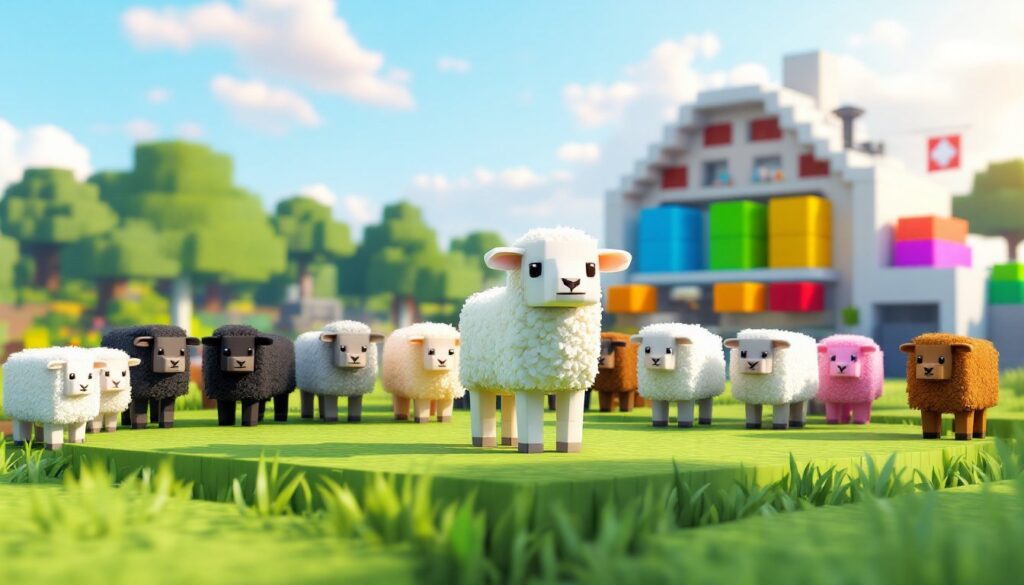
Sheep in Minecraft are deceptively simple. They wander around looking like fluffy white clouds with legs, but they’re actually one of the most useful passive mobs in the game. Wool for beds, banners for bases, carpets for decoration, and an entire color palette ready to be exploited, all from a single animal that eats grass and says “baa.”
This guide breaks down where to find them, how shearing and breeding actually work in the current 1.20+ Java and Bedrock builds, and how to set up a wool farm that prints colored blocks while a player AFKs.
Table of Contents
ToggleKey Takeaways
- Sheep in Minecraft spawn most frequently in Plains and Meadow biomes with light levels of 7 or higher, making them one of the most accessible renewable resources for early-game wool production.
- Shearing sheep with shears (rather than killing them) yields 1–3 wool blocks and keeps the animal alive to regrow wool repeatedly, making shears a cost-effective tool that pays for itself immediately.
- Pink sheep are extremely rare (roughly 1-in-600 spawn rate), while dyeing sheep with dyes allows players to instantly create any of 16 custom wool colors for infinite supply without waiting for RNG.
- Breeding two dyed sheep of the same color multiplies your flock and creates an automatic color-producing workforce; color mixing through breeding enables rare dye combinations like magenta without tedious grinding.
- An automatic wool farm using an observer, dispenser with shears, and hoppers can be scaled to 16 modules (one per color) to generate wool continuously while players are AFK, providing resources for decorated houses, banners, and carpets.
Where to Find Sheep and Which Biomes Spawn Them
Sheep spawn naturally on grass blocks in most overworld biomes with a light level of 7 or higher. They tend to appear in flocks of 2–8 during world generation, which is why players often stumble on a cluster right outside their first spawn.
The biomes with the highest sheep spawn rates include:
- Plains and Sunflower Plains
- Meadows (alongside donkeys and rabbits)
- Forest and Flower Forest
- Taiga and Snowy Plains
- Savanna (less dense, but reliable)
They won’t spawn in deserts, badlands, or oceans, so a desert spawn means a player should pack a lead and go hunting. Cross-referenced biome spawn data confirms Plains remain the most efficient hunting ground for early-game wool runs.
Natural Wool Colors and Their Spawn Rates
Not every sheep is white. The game uses weighted RNG to decide wool color at spawn, and most players never see the rare variants without actively looking.
Natural spawn rates (Java Edition 1.20):
- White: 81.836%
- Black: 5%
- Gray: 5%
- Light Gray: 5%
- Brown: 3%
- Pink: 0.164% (the unicorn)
Pink sheep are notoriously rare, roughly a 1-in-600 spawn. Players hunting one should clear chunks around a Plains biome and let the spawner do its work. Brown sheep are the most useful of the “natural” colors because brown dye requires cocoa beans, which means a jungle trip players often skip.
How to Shear Sheep for Wool Without Killing Them
Killing a sheep with a sword drops 1 wool block. Shearing it drops 1–3 wool and leaves the sheep alive to regrow its coat. The math isn’t subtle: shears win every time.
Shears cost 2 iron ingots in a diagonal recipe. Once equipped, players right-click (or use the interact button on console/Bedrock) on the sheep. The animal becomes the pink, naked version until it eats a grass block to regrow wool, which happens automatically as it wanders.
A sheared sheep can be sheared again the moment its wool returns, making them a renewable resource. Detailed shearing mechanics breakdowns note that Looting enchantments do not affect shears, so there’s no need to enchant them for wool yield.
Breeding Sheep and Passing Down Wool Colors
Sheep enter love mode when fed wheat. Two fed sheep produce a lamb after a short animation, with a 5-minute cooldown before they can breed again.
The lamb’s wool color follows specific rules:
- If both parents share a color, the lamb inherits it.
- If parents have different colors, the game checks whether those colors can be combined (like mixing dyes in a crafting grid). If yes, the lamb spawns with the mixed color.
- If the colors can’t be combined, the lamb randomly inherits one parent’s color.
For example, breeding a blue sheep with a white sheep produces a light blue lamb. This is the only way to get certain colors, like magenta, without grinding for dyes. It’s a quietly clever system most players never fully exploit.
Dyeing Sheep to Create Custom Wool Colors
Players who want a specific wool color without waiting for RNG can dye sheep directly. Right-clicking a sheep with any of the 16 dyes permanently changes its wool color. The dye is consumed, but the sheep keeps producing that color forever, even after shearing.
This is the foundation of any serious wool farm. A single lime green sheep, sheared on a loop, will out-produce hours of dye crafting. Pair this with breeding two same-colored sheep to multiply the flock, and a player has an infinite supply of any wool color in roughly 20 minutes of setup.
Quick tip: dye one of each color, name them with a name tag, and pen them separately. It saves time and prevents accidental shears of the wrong color.
Building an Efficient Automatic Wool Farm
A fully automatic wool farm uses an observer, a dispenser loaded with shears, and a sheep locked over a grass block. The observer detects the wool regrowing and triggers the dispenser, which shears the sheep instantly. Hoppers below funnel the wool into a chest.
Basic build steps:
- Place a grass block and stand a dyed sheep on it (a boat or fence-gate trick works to lock it in place).
- Place a dispenser facing the sheep, loaded with shears.
- Put an observer behind the sheep, watching the grass block face.
- Wire the observer’s output into the dispenser with redstone.
- Run a hopper minecart or hopper line under the grass to collect dropped wool.
One sheep produces wool roughly every few seconds while grass is available. Scale by stacking 16 of these modules, one per color. For players who want to push further, community-made redstone farm schematics cover compact 16-color designs that fit in a 5×5 footprint. Pair the farm with a funny Minecraft pictures break when the redstone inevitably breaks the first time, because it will.
And for anyone building amazing Minecraft houses that need rainbow carpets, awesome Minecraft houses with banner detailing, or just a cool house in Minecraft with matching bed sets, an auto wool farm pays for itself within an afternoon. Compact tutorials for the wiring layout are available through community build guides maintained by long-time redstoners.
Conclusion
Sheep in Minecraft punch well above their weight. They’re a renewable wool source, a color-mixing puzzle, and the backbone of every decoration-heavy build. Players who set up even a small dyed flock early will save hours later. Grab shears, hoard wheat, and let the flock do the work.